

For decades, the message to South African job seekers was simple: get a qualification, and the doors will open. But something has shifted. Employers across the country, from call centres in Randburg to engineering firms in Secunda, are asking a different question at interviews. Not “what did you study?” but “what can you actually do?”
This shift is called skills-based hiring, and it is quietly rewriting the rules of the job market. For millions of South Africans without a degree, it could be the most important employment trend of the decade.
RELATED: 50 South African Companies That Will Hire You With Just Matric
What Is Skills-Based Hiring?
Skills-based hiring means employers assess candidates on demonstrated abilities rather than formal qualifications. Instead of screening out anyone without a diploma or degree, companies use practical tests, work samples, trial shifts and structured assessments to find people who can do the job, regardless of where or how they learned to do it.
It sounds obvious. Of course employers want people who can do the work. But for years, qualifications were used as a shortcut. A degree on a CV was treated as proof of competence, and its absence was treated as a red flag. That shortcut is breaking down, and employers know it.
RELATED: 10 Everyday Activities That Count as Work Experience on Your CV
Why South African Employers Are Making the Switch
The Numbers Force the Issue
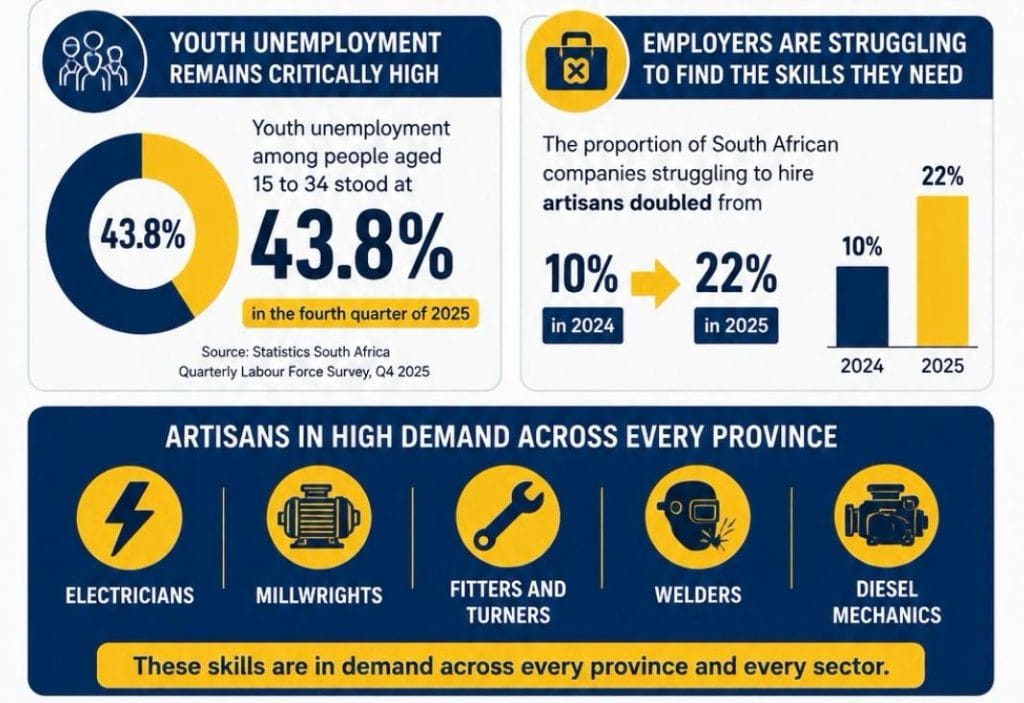
South Africa’s unemployment crisis is well documented. Youth unemployment among people aged 15 to 34 stood at 43.8% in the fourth quarter of 2025, according to Statistics South Africa’s Quarterly Labour Force Survey. At the same time, employers complain that they cannot find the skills they need. The proportion of South African companies struggling to hire artisans doubled from 10% in 2024 to 22% in 2025. Electricians, millwrights, fitters and turners, welders and diesel mechanics are in demand across every province.
That mismatch, with millions looking for work while employers cannot fill posts, tells you the old filtering system is broken. When your screening method rejects capable people and still fails to find the talent you need, it is time to change it.
The Global Trend Has Reached Us.
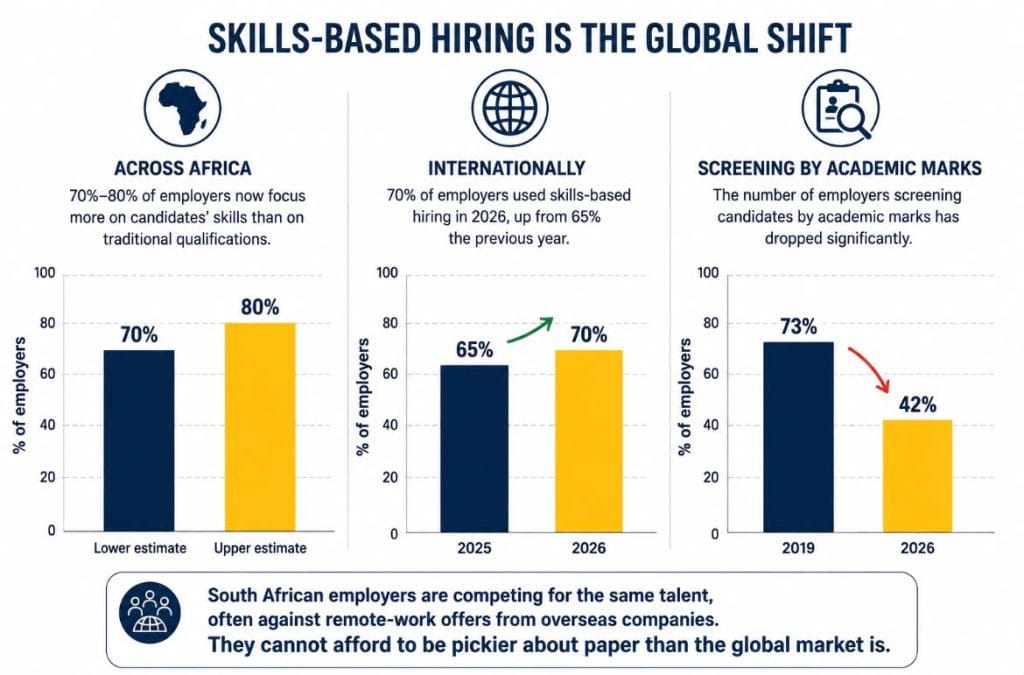
This is not just a South African story. Across Africa, roughly 70% to 80% of employers now report focusing more on candidates’ skills than on traditional qualifications. Internationally, the National Association of Colleges and Employers found that 70% of employers used skills-based hiring in 2026, up from 65% the previous year. The number screening candidates by academic marks has dropped from 73% in 2019 to just 42%.
South African employers are competing for the same talent, often against remote-work offers from overseas companies. They cannot afford to be pickier about paper than the global market is.
Qualifications Age Faster than Skills
Technology is changing jobs faster than universities and colleges can update their curricula. A three-year qualification can be partly outdated before the graduate walks across the stage. Employers in IT, digital marketing, logistics and even the trades increasingly value someone who taught themselves the latest tools over someone whose knowledge stopped at graduation. What matters is not where you learned. What matters is whether you can keep learning. What matters is whether you can keep learning. This is exactly why skills-based hiring is gaining ground, because it measures what a candidate can do today rather than what a certificate said they could do three years ago.
Practical Hiring Reduces Costly Mistakes
Local employers have also learned hard lessons about mis-hires. In frontline sectors like hospitality, retail and call centres, trial-to-hire models expanded sharply through 2026. These models let candidates work a few paid shifts before either side commits, and they grew precisely because traditional interviews were producing high first-month dropout rates. Watching someone do the job for three shifts tells an employer more than any certificate can.
What This Means for You as a Job Seeker
If you are sitting with matric and no money for further study, this trend is genuinely good news, but only if you respond to it. Skills-based hiring does not mean employers hire anyone. It means they hire people who can prove ability. Here is how to position yourself.
1. Build Evidence, Not Just Experience

A skills-based CV looks different from a traditional one. Instead of leading with education, lead with what you have done and what it achieved. Fixed your neighbourhood’s electrical faults? Managed the finances of a stokvel? Built a following for a small business on social media? These are demonstrable skills. Document them with specifics: numbers, outcomes, and references from real people who can vouch for the work.
2. Use Free and Low-cost Certifications Strategically

Short, skills-specific credentials carry growing weight. Google Career Certificates, Microsoft’s free learning paths, Coursera financial aid courses and SETA-accredited short courses all signal capability without requiring years of study or tens of thousands of rands. The National List of Occupations in High Demand, which identifies 350 occupations with sustained hiring momentum, is a useful guide for choosing which skills to certify.
3. Target Learnerships and Trial-based Employers

Learnerships remain one of the most direct skills-based routes into work in South Africa, because they combine training with workplace experience and end with a recognised qualification. Sectors like MICT, services, and wholesale and retail run intakes throughout the year. Similarly, employers using trial shifts or practical assessments are, by definition, giving you a chance to prove yourself. Seek them out.
4. Prepare for Assessments, Not Just Interviews

Skills-based employers test. That might mean an Excel exercise for an admin post, a wiring task for an electrical position, a live customer call for a contact centre role, or a writing sample for a marketing job. Practise the actual tasks of the job you want. It is far more useful interview preparation than rehearsing answers to “tell me about yourself.”
5. Learn the Language of Skills
When employers post skills-based adverts, they name competencies: “data capturing,” “stock control,” “conflict resolution,” “Pastel,” “MIG welding.” Mirror that language in your CV and applications, honestly. Applicant tracking systems and recruiters alike search for those exact terms, and a CV written in vague generalities will be invisible no matter how capable you are.
Which Sectors Are Leading the Shift?
Skills-based hiring is not spreading evenly. In South Africa, it has expanded fastest in retail, hospitality, call centres and logistics. These are high-volume sectors where performance is easy to observe, and turnover is expensive. Information technology is another leader: coding tests and portfolio reviews have largely replaced degree requirements at many software companies, and demand for digital skills, data analysis and cybersecurity keeps climbing.
The trades are a special case. Artisan roles have always been skills-based at their core, and trade tests exist precisely to certify ability. But the deepening shortage means employers are increasingly willing to fund training for candidates who show aptitude, rather than waiting for fully qualified artisans who may never arrive.
Professional fields like law, medicine, engineering and accounting still require formal qualifications, and rightly so. Skills-based hiring is not replacing regulated professions. It is opening up the enormous middle of the job market: the administrative, technical, digital, service and trade roles where ability was always what mattered anyway.
The Honest Caveat
Skills-based hiring rewards people who can demonstrate skills, which means it can still exclude those who have had no opportunity to build any. Technical competence alone is also no longer enough on its own. Employers consistently say that communication, reliability, problem-solving and the ability to learn are what separate candidates once basic skills are proven. Treat those so-called soft skills as hard requirements, because employers do.
The Bottom Line
The degree is not dead, but its monopoly is. South African employers, squeezed between a skills shortage and a talent pool full of capable people without formal credentials, are learning to hire for ability. Your job is to make that ability impossible to miss. Build it, document it, certify it where you can, and walk into every assessment ready to show, not just tell, what you can do.
Frequently Asked Questions (FAQs)
Can I really get a job in South Africa without a degree?
Yes, particularly in retail, hospitality, call centres, logistics, IT and the trades, where employers increasingly use practical tests and trial shifts instead of qualification screening. You will still need to prove your skills, so focus on building evidence of what you can do.
What is the difference between skills-based hiring and traditional hiring?
Traditional hiring screens candidates by the qualifications and experience listed on a CV. Skills-based hiring assesses actual ability through tests, work samples, portfolios and trial periods, so capable candidates without formal credentials are not filtered out automatically.
Which skills are most in demand in South Africa right now?
Artisan trades (electricians, millwrights, welders, diesel mechanics), IT and digital skills (data analysis, cybersecurity, software development), engineering, healthcare, and frontline service skills all feature strongly. The National List of Occupations in High Demand identifies 350 such occupations.
How do I prove my skills if I have no formal work experience?
Use portfolios, short-course certificates, references from informal work, volunteer projects and community roles. Practical assessments and learnerships also let you demonstrate ability directly, without a work history behind you.
Do learnerships count as skills-based hiring?
Learnerships are one of the best skills-based pathways in South Africa. They select for potential rather than qualifications, train you on the job, pay a stipend, and end with an accredited qualification, turning demonstrated ability into a formal credential.