


Look at almost any job advert in South Africa, from cashier to civil engineer, and you will find the same line buried in the requirements: strong problem-solving skills. It appears so often that most applicants skim past it. Then they write “excellent problem solver” on their CV, submit it, and wonder why nobody calls.
- What Employers Actually Mean by Problem-Solving Skills
- Why Problem-Solving Skills Matter More Than Ever
- A Simple Framework You Can Actually Use
- How to Develop Problem-Solving Skills Without a Job
- How to Prove Your Problem-Solving Skills on Your CV
- How to Prove Your Problem-Solving Skills in an Interview
- Free Tools That Help You Present the Skill
- Mistakes That Undermine Your Case
- Frequently Asked Questions (FAQs)
- Start Building the Evidence Now
The issue is that problem-solving skills are the single most claimed and least demonstrated ability in the job market. Employers know this. They have stopped believing the claim and started testing for it instead. This guide covers what hiring managers actually mean by the phrase, how to build the skill deliberately, and how to prove it convincingly at every stage of an application.
What Employers Actually Mean by Problem-Solving Skills
When a manager says they want someone with problem-solving skills, they are rarely talking about intelligence or puzzles. They are talking about a specific behaviour: what you do when something goes wrong, and nobody has told you what to do next.
In practice, they are checking whether you can do five things:
- Notice that a problem exists before it becomes a crisis
- Work out what is actually causing it rather than reacting to the symptom
- Generate more than one possible response
- Choose one and act on it within your authority
- Check whether it worked and adjust if it did not
Notice what is missing from that list. Nothing about being right the first time. Employers are not looking for people who never make mistakes. They are looking for people who do not freeze, do not panic, and do not need supervision for every small decision.
RELATED: Skills-based hiring in South Africa and what it means for young job seekers
Why Problem-Solving Skills Matter More Than Ever

Two things have made problem-solving skills more valuable than at any point in the last decade.
The first is automation. Routine, rule-following tasks are increasingly handled by software. The World Economic Forum, which publishes annual research on workforce trends at weforum.org, has consistently ranked analytical thinking and complex problem-solving among the top skills employers say they need. What remains for people is the messy work that has no script.
The second is leanness. South African employers are running smaller teams under tighter budgets. Fewer supervisors means each person is expected to absorb more judgement calls independently. A junior employee who solves things quietly is worth several who escalate everything.
This is why problem-solving skills survive as a requirement across wildly different roles. A retail supervisor handling a stock discrepancy and a software developer debugging a payment failure are doing the same underlying work.
A Simple Framework You Can Actually Use
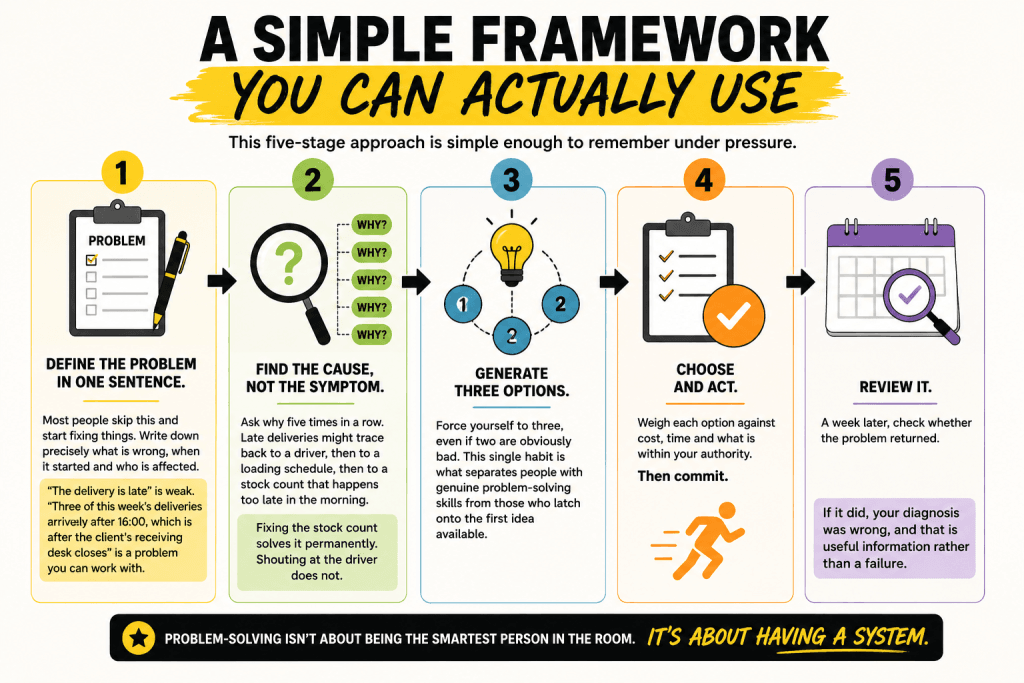
Vague advice about “thinking critically” helps nobody. Use a structure instead. This five-stage approach is simple enough to remember under pressure.
Define the problem in one sentence. Most people skip this and start fixing things. Write down precisely what is wrong, when it started and who is affected. “The delivery is late” is weak. “Three of this week’s deliveries arrived after 16:00, which is after the client’s receiving desk closes” is a problem you can work with.
Find the cause, not the symptom. Ask why five times in a row. Late deliveries might trace back to a driver, then to a loading schedule, then to a stock count that happens too late in the morning. Fixing the stock count solves it permanently. Shouting at the driver does not.
Generate three options. Force yourself to three, even if two are obviously bad. This single habit is what separates people with genuine problem-solving skills from those who latch onto the first idea available.
Choose and act. Weigh each option against cost, time and what is within your authority. Then commit.
Review it. A week later, check whether the problem returned. If it did, your diagnosis was wrong, and that is useful information rather than a failure.
How to Develop Problem-Solving Skills Without a Job
You do not need employment to build this. Problem-solving skills grow through deliberate practice, and practice is available everywhere.
Take on real logistical problems. Volunteer to organise something with genuine constraints: a church event with a fixed budget, a school fundraiser, a stokvel payout schedule, a community clean-up. Constraints are what create the skill. Anyone can plan an event with unlimited money.
Learn a structured discipline. Basic coding, spreadsheet modelling and data analysis all train you to break large problems into small ones. Free courses are available on Coursera, Alison and Khan Academy. Platforms like Brilliant offer daily logic and reasoning practice.
Fix things in your own life. Reduce your household’s monthly data spend by 30 per cent. Cut your commute cost. Redesign how your family tracks grocery money. These are legitimate problems with measurable outcomes, and measurable outcomes are exactly what you need later.
Study failures. When something goes wrong at a shop, a taxi rank or a government office, mentally diagnose it. What is the actual bottleneck? What would you change? This costs nothing and rewires how you see systems.
RELATED: Free short courses you can complete online to boost your CV
How to Prove Your Problem-Solving Skills on Your CV
Delete the phrase “excellent problem-solving skills” from your CV right now. It carries zero information. Replace it with evidence.
The formula is simple: problem, action, result, number.
Weak: “Responsible for stock management.”
Strong: “Identified a recurring stock count error causing weekly shortages, redesigned the count schedule, and reduced out-of-stock incidents from 12 per month to 2.”
You do not need a corporate job to write lines like this. A student can write about restructuring a group assignment after two members dropped out. A volunteer can write about cutting an event’s catering cost by a third after a sponsor withdrew.
Quantify wherever possible. Numbers signal that you measured the outcome, which is itself proof of the review stage most people skip.
RELATED: How to create a skills portfolio using free tools
How to Prove Your Problem-Solving Skills in an Interview
Almost every interview now includes a behavioural question aimed squarely at this: “Tell me about a time you faced an unexpected challenge.” Answer with the STAR structure.
Situation. One sentence of context. Keep it short.
Task. What you specifically were responsible for. Say “I”, not “we”.
Action. The bulk of your answer. Walk through your reasoning, including the options you rejected and why. Interviewers care more about your thinking than your outcome.
Result. What changed, ideally with a number, and what you learned.
Prepare three of these stories before any interview: one about a conflict, one about a deadline or resource crisis, and one about a mistake you made and corrected. The third is the one candidates avoid, and it is often the most persuasive, because it demonstrates the review stage honestly.
Practise them out loud. Reasoning that feels clear in your head frequently collapses when spoken.
Free Tools That Help You Present the Skill
Building problem-solving skills is one job. Packaging them is another. The free Nasi iSpani tools at nasi-ispani.co.za/tools handle the packaging side.
The CV Builder gives you a clean structure to slot your problem, action, result lines into. The ATS Resume Scanner checks your CV against a specific advert and flags missing keywords, which matters because large employers filter applications by software before a person reads them. AI Buddy can help you rewrite a flat duty statement into an evidence-based one, and the Job Tracker keeps your applications and follow-ups organised. All of it is free with an account.
RELATED: How to use the Nasi iSpani ATS Resume Scanner to improve your CV
Mistakes That Undermine Your Case
Claiming the skill without evidence is the obvious one. There are subtler failures too.
Telling a story where you escalated the problem to a manager and stopped. That is compliance, not problem solving. Choosing an example so small that it reads as trivial. Blaming colleagues or previous employers in your answer, which signals that you diagnose people rather than causes. Giving the outcome without the reasoning, which leaves the interviewer unable to tell whether you solved it or got lucky.
Frequently Asked Questions (FAQs)
Can problem-solving skills be learned, or are they innate?
They are learned. The core of the skill is a repeatable process rather than raw talent, and structured practice on real constraints improves it measurably.
What if I have never had a job to draw examples from?
Use academic projects, volunteer work, family responsibilities or self-directed projects. Employers accept these readily from entry-level candidates, provided the problem was real, and you can describe your reasoning.
How do I show problem-solving skills in an aptitude test?
Most tests measure reasoning under time pressure. Practise numerical, verbal and diagrammatic reasoning tests beforehand, and work methodically rather than rushing. Accuracy usually scores higher than speed.
Are problem-solving skills the same as critical thinking?
They overlap but differ. Critical thinking is about evaluating information and arguments. Problem-solving is about acting on a situation to change it. Employers usually want both.
Should I list problem-solving skills in my CV skills section?
Only alongside a concrete example elsewhere in the document. A bare mention in a skills list is ignored, but the phrase is worth including once because applicant tracking software often scans for it.
How long does it take to develop problem-solving skills?
You can improve noticeably within a few months of deliberate practice. Take on one real project with genuine constraints, work through it using a structured process, and record what happened.
Start Building the Evidence Now
Problem-solving skills are unusual among employability skills because you can build them and prove them at the same time. Every real problem you take on becomes both practice and a story you can tell. Pick one this week, something with a genuine constraint attached, work through it properly, and write down what changed. That single paragraph will do more for your next application than any adjective you could add to your CV.