


Every job advert asks for something slightly different, but scroll through enough of them, and one requirement keeps appearing: the ability to work under pressure and meet deadlines. That is a polite way of saying employers want strong time management skills. In a competitive job market where thousands of young people apply for the same position, the candidate who can prove they use their hours well often walks away with the offer.
- Why Employers Care So Much About Time Management Skills
- The Core Time Management Skills Employers Look For:
- How to Prove Your Time Management Skills to Employers
- Tools That Support Good Time Management Skills
- Common Time Management Mistakes to Avoid
- Frequently Asked Questions
- Start Building Your Time Management Skills Today
The good news is that time management skills are learnable. You do not need a degree, expensive software, or years of experience to start building them. You need a system, a bit of self-awareness, and the discipline to stick with it long enough for it to become a habit.
This guide breaks down the specific time management skills hiring managers look for, how to develop each one, and how to show them off during your job search.
RELATED: Productivity Tools Every Student and Job Seeker Should Use
Why Employers Care So Much About Time Management Skills

Time is the one resource a business cannot buy more of. When an employee misses deadlines, arrives late, or spends three hours on a task that should take one, the cost lands somewhere. A colleague picks up the slack. A client receives their work late. A project slips a week and pushes everything behind it.
Managers are not only assessing whether you can do the work. They are assessing whether they will have to chase you to get it done. Someone with solid time management skills is low maintenance in the best possible way. They can be handed a task and trusted to deliver it without daily check-ins.
There is also a promotion angle. Research published by Harvard Business Review has repeatedly shown that professionals who plan and prioritise well are given more responsibility sooner, simply because leaders learn they can rely on them. In an entry-level role, being the person who always delivers on time is one of the fastest routes to being noticed.
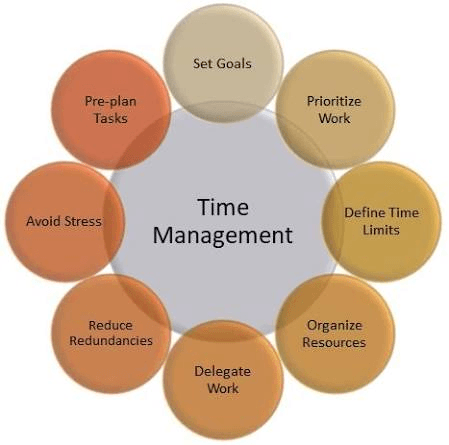
The Core Time Management Skills Employers Look For:
Prioritisation
Not every task carries the same weight. Prioritisation is the ability to look at a list of ten things and correctly identify which two actually matter today.
A simple method is the Eisenhower Matrix, which sorts tasks into four groups: urgent and important, important but not urgent, urgent but not important, and neither. Most people spend their day drowning in the third category, answering messages and reacting to small requests while the work that moves the needle sits untouched.
Practise this by starting each morning with a short list. Write down everything you need to do, then mark the top three items that would make the day a success even if nothing else got finished. Do those first.
Planning and Scheduling
Planning turns a vague intention into a fixed appointment with yourself. Time blocking is the most effective version of this: instead of writing “work on report” on a to-do list, you write “09:00 to 11:00, draft report” in your calendar.
The difference matters because open-ended tasks expand to fill whatever time is available. A blocked-out slot creates a natural boundary. Free tools like Google Calendar make this easy, and most employers already run on a shared calendar system, so arriving with the habit already formed is a genuine advantage.
RELATED: What to do in the first week of a job
Meeting Deadlines Consistently
Deadline reliability is arguably the most visible of all time management skills. It is also the one most easily damaged. A person who delivers late twice will be remembered for those two occasions, not the twenty times they were early.
The trick is to build in a buffer. If a report is due Friday, set your personal deadline for Wednesday. That gap absorbs the load shedding, the sick day, the file that corrupts, and the last-minute request from another department. If nothing goes wrong, you look exceptional. If something does, you still deliver on time.
Estimating How Long Work Actually Takes
Most people are terrible at this, and it is the hidden reason so many deadlines slip. Psychologists call it the planning fallacy: we imagine the smooth version of a task and forget the interruptions, revisions, and problems that always appear.
Fix it with data. For two weeks, write down how long you estimated a task would take and how long it actually took. You will quickly spot your personal multiplier. Many people find that whatever they guess, the truth is closer to one and a half times that number. Once you know your multiplier, your promises to employers become far more accurate.
Focus and Managing Distractions
You can plan brilliantly and still achieve nothing if your attention leaks away every four minutes. Deep focus is increasingly rare, which is exactly why it is valuable.
The Pomodoro Technique is a well-tested approach: work for twenty-five minutes without interruption, then take a five-minute break, and repeat. After four rounds, take a longer break. It works because it makes concentration finite and therefore manageable.
Beyond technique, remove the friction. Put your phone in a drawer rather than face down on the desk. Close the tabs you are not using. Turn off notifications for anything that is not genuinely urgent. Attention protected is time gained.
Punctuality
It sounds basic, but punctuality is a signal. Arriving on time for a shift, a meeting, or an interview tells an employer you respect other people’s schedules. Arriving late tells them the opposite, regardless of the reason you give.
In South African cities, traffic and public transport delays are a real factor, so build the delay into your plan rather than hoping it will not happen. Leave earlier than feels necessary. The candidate who arrives fifteen minutes early and reads over their notes is calmer, sharper, and more impressive than the one who rushes in apologising.
RELATED: Preparing for an interview
Saying No and Asking for Help
Strong time management skills include knowing your limits. Taking on more than you can deliver is not commitment; it is a future missed deadline you have agreed to in advance.
You do not need to refuse bluntly. Try: “I can take that on, but it would push the client report to Thursday. Which would you prefer I prioritise?” That response shows awareness of workload and trade-offs, which is exactly the thinking managers want to see.
Equally, flagging early when something is going wrong is a skill. A problem raised on Monday is manageable. The same problem revealed on Friday afternoon is a crisis.
Managing Energy, Not Only Hours
Two hours at 09:00 are not the same as two hours at 16:00. Most people have a window in the day when their concentration is sharpest. Identify yours and protect it for the hardest work. Save routine admin, filing, and email for the low energy stretch.
Rest is part of this. Skipping lunch and working through fatigue produces slow, error-filled work that has to be redone. Employers do not benefit from an exhausted employee, whatever the culture of long hours might suggest.
How to Prove Your Time Management Skills to Employers

Listing “good time management” on a CV means very little because everyone writes it. Evidence is what convinces.
On your CV, attach the skill to a result. Instead of a bare claim, write something like: “Coordinated a five-person volunteer team for a community event, delivering all preparation two days ahead of schedule.” That sentence demonstrates planning, prioritisation, and deadline management without ever using the phrase.
In an interview, expect a behavioural question such as “Tell me about a time you had to juggle competing deadlines.” Answer with a structure: describe the situation, explain what you did, and end with the outcome. Name the method you used, whether that was time blocking, a priority list, or negotiating a deadline with a supervisor. Specifics are believable in a way that general claims are not.
You can also demonstrate time management skills before you say a word. Submitting your application well before the closing date, replying to emails promptly, and arriving early for the interview all quietly prove the point.
Tools That Support Good Time Management Skills
Tools do not replace discipline, but they reduce the effort of staying organised. A shared calendar handles scheduling. A task manager such as Trello or Asana keeps projects visible and stops work from living only in your head. A simple notebook works too, and many highly organised people never move beyond one.
Choose one system and use it consistently. Switching between five apps is itself a form of procrastination.
Common Time Management Mistakes to Avoid

Multitasking is the biggest one. Switching between tasks feels productive but costs concentration every time you change focus, and the total time spent goes up rather than down.
Perfectionism is another. Spending four hours polishing a task that needed one hour steals time from everything else on your list. Learn the difference between work that must be excellent and work that simply needs to be finished.
Finally, avoid planning only in your head. Memory is unreliable and mental lists create low-level anxiety. Write things down and free your attention for the work itself.
Frequently Asked Questions
What are the most important time management skills for a first job?
Prioritisation, punctuality, and meeting deadlines matter most in an entry-level role. Managers need to know that work handed to you will come back on time and that you will be where you are meant to be.
How do I improve my time management skills quickly?
Start with one habit rather than a full system. Plan tomorrow’s top three tasks before you finish today, and block time in a calendar for the most important one. Add further techniques only once that habit sticks.
How do I answer interview questions about time management skills?
Use a real example with a clear result. Describe the competing demands you faced, the method you used to decide what came first, and what you delivered. Naming a specific approach makes the answer credible.
Do employers actually test time management skills?
Sometimes directly, through timed assessments or task-based exercises, but usually indirectly. Whether you applied before the deadline, replied promptly, and arrived on time are all quietly noted.
Is being busy the same as being productive?
No. Busyness measures activity while productivity measures results. Strong time management skills are about finishing the work that matters, not filling every hour.
Start Building Your Time Management Skills Today
Time management skills are not about squeezing more tasks into a day. They are about making deliberate choices, protecting your attention, and building a reputation as someone who delivers. That reputation compounds. It leads to better projects, more responsibility, and stronger references.
Start small. Choose one habit from this article, apply it for two weeks, and notice the difference. Employers will notice too.
Boost your chances: Work-Ready Essentials, 54 min free course