

Technology is one of the fastest-changing areas of the modern job market, but you do not have to become a programmer to build a career in tech. In fact, there are several entry-level tech careers that don’t require coding and can provide a pathway into the growing digital economy.
- 1. IT Support Specialist
- 2. Cybersecurity Analyst
- 3. Digital Marketing Specialist
- 4. UX/UI Designer
- 5. Project Coordinator
- 6. Technical Writer
- 7. Customer Success Specialist
- 8. Data Analyst
- 9. Quality Assurance Tester
- 10. SEO Specialist
- How To Get Started In A Tech Career Without Coding
- Why These Careers Are Worth Considering
- Take The First Step Towards A Tech Career
- Frequently Asked Questions(FAQs)
From helping users solve technical problems to managing digital projects, creating engaging online experiences and protecting company information, technology companies need people with a wide range of skills.
This is particularly encouraging for job seekers who are interested in technology but may not have a background in computer science or programming.
The technology sector continues to offer strong employment opportunities, with computer and information technology occupations expected to grow significantly between 2024 and 2034. An estimated 317,700 job openings could become available each year, creating opportunities for people looking to build careers in the digital economy.
So, what are the best entry-level tech careers that don’t require coding?
1. IT Support Specialist

IT support is one of the most accessible ways to enter the technology industry without becoming a programmer.
IT support specialists help employees or customers resolve technical problems involving computers, software, networks, accounts and other digital tools. Their responsibilities may include setting up devices, troubleshooting software, responding to support tickets and explaining technical solutions to non-technical users.
You do not necessarily need a university degree to get started. The U.S. Bureau of Labour Statistics notes that some computer support specialists can qualify with a high school diploma and relevant IT certifications.
Useful skills include:
- Problem-solving
- Customer service
- Communication
- Basic computer knowledge
- Troubleshooting
- Patience and attention to detail
Certifications such as CompTIA A+ can also help demonstrate your technical knowledge to potential employers.
IT support can be more than an entry-level job. It can provide experience that eventually leads to careers in networking, systems administration, cybersecurity or IT management.
RELATED: How to Start a Career in IT Without a Degree
2. Cybersecurity Analyst

Cybersecurity is another technology career that can appeal to people who do not want to become programmers.
Cybersecurity professionals help organisations protect their systems, networks and information from cyber threats. Entry-level roles can include security operations centre analyst, junior security analyst, security administrator and cybersecurity support roles.
While advanced cybersecurity positions may require significant technical expertise, you can begin by learning fundamental concepts such as network security, passwords, phishing, malware, access controls and security monitoring.
It is important to understand that cybersecurity is not completely free from technical skills. You may eventually need to learn some scripting, networking or command-line tools as you progress. However, coding is not the central focus of every cybersecurity role.
The field has strong long-term potential. According to the U.S. Bureau of Labor Statistics, employment of information security analysts is projected to grow by 29% from 2024 to 2034.
RELATED: How to Build Your Digital Skills for the Modern Workplace
3. Digital Marketing Specialist

Digital marketing combines technology, communication and creativity.
Digital marketing specialists may manage social media campaigns, email marketing, search engine optimisation, online advertising, websites and digital content.
This is an excellent option for people who enjoy writing, design, communication, research or analysing trends.
You can develop practical experience without a formal technology degree by creating your own portfolio. For example, you could create a mock social media campaign for a business, write SEO-friendly blog posts or develop a simple digital marketing strategy.
Important skills include:
- Social media management
- SEO
- Content creation
- Analytics
- Email marketing
- Communication
- Basic graphic design
Digital marketing also offers opportunities across industries because almost every organisation needs an online presence.
The BLS lists market research analysts and marketing specialists among business occupations with substantial projected annual openings, showing the broader demand for marketing-related skills.
4. UX/UI Designer

If you are creative and interested in how people interact with websites and apps, UX or UI design could be worth exploring.
UX stands for user experience, while UI stands for user interface. UX professionals focus on making digital products easy and enjoyable to use. UI designers focus more heavily on the visual interface, including layouts, buttons, typography and other elements.
Coding is not normally the primary responsibility of a designer.
Instead, you may use tools such as Figma to create wireframes, prototypes and interface designs.
A strong portfolio can be particularly valuable when applying for junior roles. You could create sample projects that demonstrate how you would improve the experience of an existing website or app.
Skills to develop include:
- User research
- Wireframing
- Prototyping
- Visual design
- Communication
- Problem-solving
- Understanding user behaviour
5. Project Coordinator

Technology projects require people who can keep teams, deadlines and tasks organised.
A junior project coordinator or technology project coordinator may help schedule meetings, track deliverables, update project documentation, communicate with team members and monitor deadlines.
You do not need to be the person building the technology to contribute to a technology project.
You could work alongside developers, designers, marketers, analysts and business teams while focusing on coordination and delivery.
Project management skills are increasingly valuable across many industries. BLS data identifies project management specialists as an occupation with projected annual openings and strong demand for project management skills.
Useful skills include:
- Organisation
- Time management
- Communication
- Leadership
- Documentation
- Teamwork
- Problem-solving
Tools such as Trello, Asana, Jira, Monday.com and Microsoft Project can also strengthen your CV.
6. Technical Writer

Technical writing is an excellent option for people who enjoy writing and explaining complicated subjects in simple language.
Technical writers create documentation such as user guides, FAQs, product instructions, knowledge-base articles and internal documentation.
Technology companies need people who can explain how products and services work to customers and employees.
You may need to understand technical concepts, but you do not necessarily need to build the technology yourself.
A strong technical writer needs excellent writing, research and communication skills. Familiarity with documentation platforms, content management systems and basic technology concepts can also be useful.
To build experience, create sample documents explaining how to use common software or digital tools.
7. Customer Success Specialist
Customer success roles sit at the intersection of technology, customer service and business.
A customer success specialist helps customers get value from a company’s technology product or service. Responsibilities can include onboarding new customers, providing training, answering questions, monitoring customer needs and helping resolve problems.
This can be a good career choice if you are confident communicating with people and enjoy learning how technology works.
You do not necessarily need programming skills. Instead, employers often value communication, relationship management, organisation and problem-solving.
Customer success can also provide a pathway into account management, sales, operations or product-related roles.
8. Data Analyst

Data analytics can be a more technical career, but entry-level data roles do not always require traditional software development skills.
Data analysts work with information to identify patterns, create reports and help organisations make better decisions.
You may need to learn tools such as Microsoft Excel, Power BI, Tableau and eventually SQL. SQL is technically a query language rather than traditional software development, but it is still a technical skill worth learning if you want to progress in analytics.
For beginners, Excel is a good starting point.
Learn how to use:
- Pivot tables
- Charts
- Formulas
- Data cleaning
- Conditional formatting
- Basic dashboards
You can then build a portfolio by analysing publicly available datasets and presenting your findings.
9. Quality Assurance Tester

Quality assurance, or QA, involves checking software and digital products to identify problems before they reach users.
A junior QA tester may follow test cases, identify bugs, document problems and check whether software works as expected.
Some QA positions require programming or automated testing skills, but manual testing roles can provide an entry point without extensive coding knowledge.
Attention to detail is particularly important because testers need to identify inconsistencies and reproduce problems accurately.
You can build relevant skills by learning software testing terminology and practising with websites or applications.
10. SEO Specialist

Search engine optimisation is another technology-focused career that does not necessarily require coding.
SEO specialists help websites improve their visibility in search engines. Their work can involve keyword research, content optimisation, technical SEO, competitor research and performance analysis.
Basic HTML knowledge can eventually be useful, but you can begin with SEO fundamentals without becoming a developer.
Learn about:
- Keyword research
- Search intent
- On-page SEO
- Content optimisation
- Link building
- Google Search Console
- Analytics
- SEO reporting
SEO can be particularly attractive to people who enjoy research, writing, marketing and analysing data.
How To Get Started In A Tech Career Without Coding
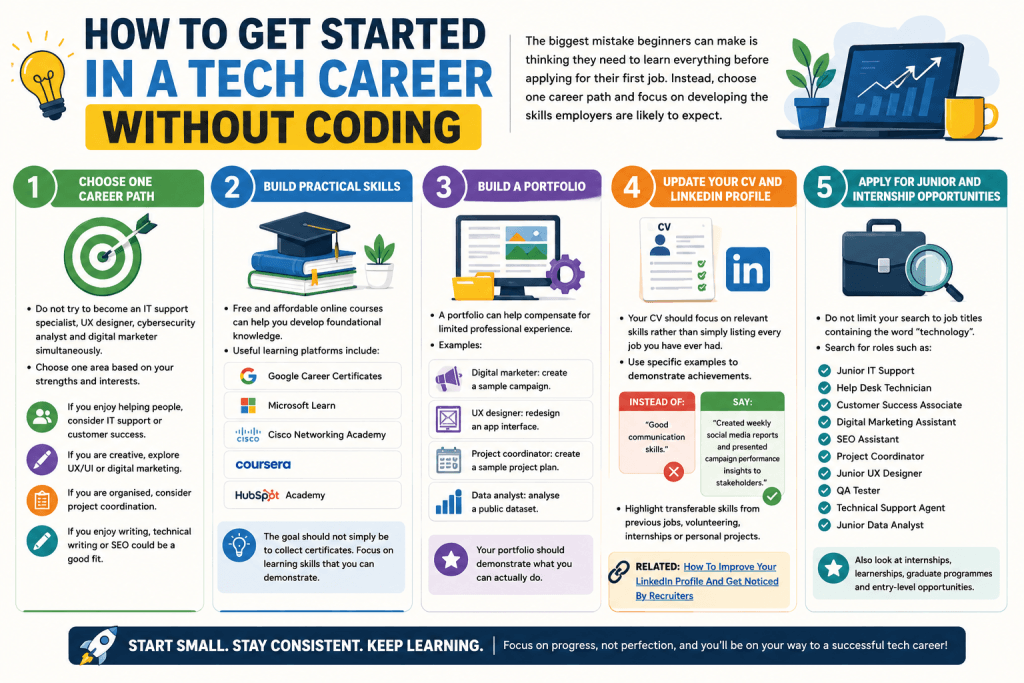
The biggest mistake beginners can make is thinking they need to learn everything before applying for their first job.
Instead, choose one career path and focus on developing the skills employers are likely to expect.
1. Choose One Career Path
Do not try to become an IT support specialist, UX designer, cybersecurity analyst and digital marketer simultaneously.
Choose one area based on your strengths and interests.
If you enjoy helping people, consider IT support or customer success.
If you are creative, explore UX/UI or digital marketing.
If you are organised, consider project coordination.
If you enjoy writing, technical writing or SEO could be a good fit.
2. Build Practical Skills
Free and affordable online courses can help you develop foundational knowledge.
Useful learning platforms include:
The goal should not simply be to collect certificates. Focus on learning skills that you can demonstrate.
3. Build A Portfolio
A portfolio can help compensate for limited professional experience.
For example, an aspiring digital marketer could create a sample campaign. A UX designer could redesign an app interface. A project coordinator could create a sample project plan. An aspiring data analyst could analyse a public dataset.
Your portfolio should demonstrate what you can actually do.
4. Update Your CV And LinkedIn Profile
Your CV should focus on relevant skills rather than simply listing every job you have ever had.
Use specific examples to demonstrate achievements.
Instead of saying:
“Good communication skills.”
Say:
“Created weekly social media reports and presented campaign performance insights to stakeholders.”
You can also highlight transferable skills from previous jobs, volunteering, internships or personal projects.
RELATED: How To Improve Your LinkedIn Profile And Get Noticed By Recruiters
5. Apply For Junior And Internship Opportunities
Do not limit your search to job titles containing the word “technology”.
Search for roles such as:
- Junior IT Support
- Help Desk Technician
- Customer Success Associate
- Digital Marketing Assistant
- SEO Assistant
- Project Coordinator
- Junior UX Designer
- QA Tester
- Technical Support Agent
- Junior Data Analyst
Also look at internships, learnerships, graduate programmes and entry-level opportunities.
Why These Careers Are Worth Considering
Technology is not just about writing code.
Modern organisations need people who can support users, manage projects, communicate with customers, analyse information, design experiences, create content and protect digital systems.
The BLS notes that communication, customer service, adaptability, leadership and project management are important skills across a range of occupations.
This means your existing strengths can be valuable in the technology industry.
Someone with excellent communication skills may thrive in customer success. Someone who enjoys solving problems may excel in IT support. A creative person may enjoy UX design. An organised person could become a project coordinator.
The key is to identify the technology career that matches your strengths and then deliberately develop the technical knowledge required for that role.
Take The First Step Towards A Tech Career
The best entry-level tech careers that don’t require coding are not necessarily the jobs with the lowest technical requirements. They are careers where you can use technology without needing to become a software developer.
IT support, cybersecurity, digital marketing, UX/UI design, project coordination, technical writing, customer success, data analysis, QA testing and SEO can all provide different pathways into the digital economy.
Some of these careers may eventually require you to develop more technical skills, but you can start by learning the fundamentals, building practical projects and gaining experience.
You do not need to know how to code to start exploring a career in technology. You need a willingness to learn, a clear career direction and evidence that you can solve problems and add value.
Frequently Asked Questions(FAQs)
What Are The Best Entry-Level Tech Careers That Don’t Require Coding?
Some of the strongest options include IT support, digital marketing, project coordination, technical writing, customer success, UX/UI design, SEO and manual QA testing. The right option depends on your interests, strengths and willingness to learn technical tools.
Can I Get A Tech Job Without A Computer Science Degree?
Yes. Some technology roles place greater emphasis on practical skills, certifications, portfolios and experience than on having a computer science degree. IT support, digital marketing and some customer-focused technology roles can be accessible through alternative training routes.
Is IT Support A Good First Tech Job?
Yes. IT support can provide practical experience with hardware, software, users, troubleshooting and technology systems. The BLS notes that some computer support positions can be entered with relevant certifications rather than a bachelor’s degree.
Do Cybersecurity Jobs Require Coding?
Not always. Many cybersecurity roles focus on monitoring, risk, security operations, compliance and incident response. However, learning networking, operating systems and eventually some scripting can help you progress.
What Tech Career Is Best For Someone Who Likes Writing?
Technical writing, digital marketing, content strategy and SEO are strong options. These careers allow you to work with technology while making communication and writing central to your work.
Can I Work In Tech If I Am Not Good At Maths?
Absolutely. Many tech careers do not involve advanced mathematics. Roles such as IT support, UX design, digital marketing, customer success, project coordination and technical writing rely more heavily on communication, organisation, creativity and problem-solving.
How Can I Get Tech Experience Without A Job?
Create your own projects, volunteer to help organisations with digital tasks, complete online courses, build a portfolio and apply for internships or entry-level programmes. Practical projects can give you evidence of your abilities before you have formal work experience.
Should I Learn Coding Anyway?
Learning basic coding can be useful, even if your chosen career does not require it. However, you do not need to become a programmer to enter the technology industry. Start by mastering the skills directly relevant to your target role and expand your technical knowledge as your career develops.