


Applying to university in South Africa for 2027? You are in the right place. This guide covers every application deadline, APS requirement, document checklist, NSFAS step, and common mistake, everything a Grade 11 or Grade 12 student needs to apply with confidence for the 2027 intake.
- What Makes 2027 Applications Particularly Competitive
- 2027 University Application Deadlines in South Africa
- Step-by-Step: How to Apply to a South African University in 2026
- Documents Required for University Applications in South Africa
- Understanding Your APS Score: What It Means and How to Calculate It
- CAO vs Direct Applications: Which One Do You Use?
- NSFAS 2027: How to Apply for Financial Aid
- Early vs Late Applications: Why Competitive Degrees Fill Up First
- 8 Common University Application Mistakes to Avoid
- How to Track Your University Application Status
- Apply Smarter: Strategy for 2027 University Applications
- All South African Universities 2027 Application Links
- Traditional Universities
- Universities of Technology
- Comprehensive Universities
- Frequently Asked Questions About University Applications 2027
South Africa has 26 public universities, and no two of them work exactly the same way. Some use the Central Applications Office (CAO). Others require direct applications. Competitive programmes close months before the general deadline. And every year, thousands of students miss their university place because of a date they did not check, a document they forgot to certify, or a portal they applied through incorrectly.
This guide is built to make sure that does not happen to you.
What Makes 2027 Applications Particularly Competitive
- Record-high matric pass rates mean more APS-eligible applicants than ever before
- Limited physical campus capacity at top institutions has not grown proportionally
- NSFAS funding pressure means more students can now afford to apply, increasing competition
2027 University Application Deadlines in South Africa
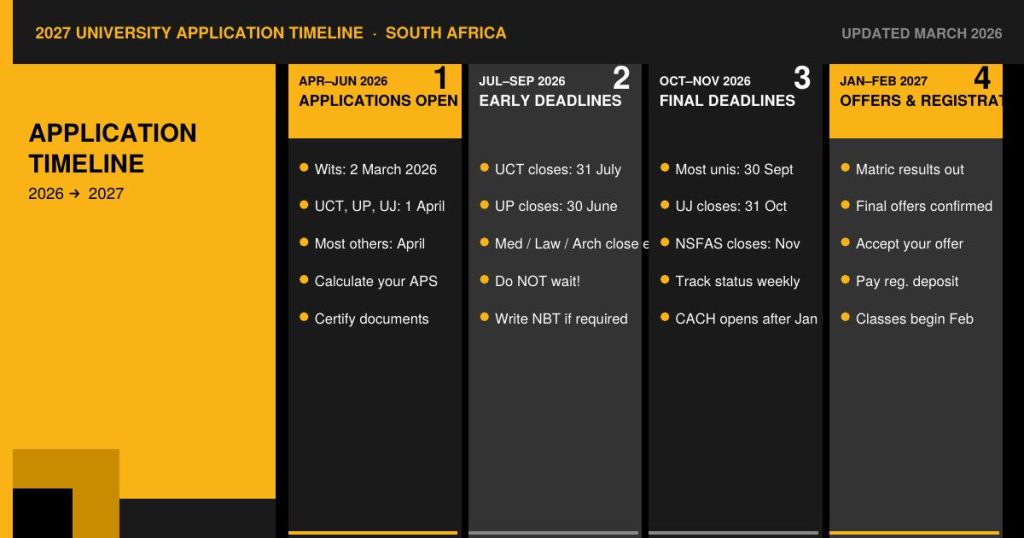
These are the confirmed and expected application windows for South Africa’s major universities for the 2027 intake. Always verify the exact dates on the official university website, as they are subject to change. University application deadlines for 2027 vary significantly by institution and by programme — do not assume all programmes at the same university share the same closing date.
| University | Applications Open | Early / Programme Deadline | General Closing Date | How to Apply |
|---|---|---|---|---|
| University of Cape Town (UCT) | 1 Apr 2026 | UG: 31 Jul 2026 | 31 Jul 2026 | Direct |
| University of the Witwatersrand (Wits) | 1 Mar 2026 | Health / Arch / Film: 30 Jun | 30 Sep 2026 | Direct |
| Stellenbosch University (SU) | 1 Apr 2026 | UG & Residence: 31 Jul | 31 Jul 2026 | Direct |
| University of Pretoria (UP / Tuks) | 1 Apr 2026 | Vet Science: 31 May | 30 Jun 2026 | Direct |
| University of Johannesburg (UJ) | 1 Apr 2026 | — | 31 Oct 2026 | Direct |
| University of KwaZulu-Natal (UKZN) | Apr 2026 | Medicine: 30 Jun | 30 Sep 2026 | CAO |
| University of the Western Cape (UWC) | Apr 2026 | — | 30 Sep 2026 | Direct |
| Rhodes University | 1 May 2026 | UG: 30 Sep | Nov 2026 (PG) | Direct |
| University of the Free State (UFS) | 1 Apr 2026 | Medical/Health: 31 May | 30 Sep 2026 | Direct |
| University of Limpopo (UL) | 1 Apr 2026 | — | 30 Sep 2026 | Direct |
| North-West University (NWU) | 1 Apr 2026 | Some progs: 30 May | 31 Aug 2026 | Direct |
| Nelson Mandela University (NMU) | 1 Apr 2026 | MBChB/BPharm/BRad: 30 Jun | 30 Sep 2026 | Direct |
| Sefako Makgatho HSU (SMU) | 1 Apr 2026 | UG: 31 Jul | 30 Aug 2026 (PG) | Direct |
| University of Fort Hare (UFH) | 1 Jun 2026 | — | 31 Oct 2026 | Direct |
| Walter Sisulu University (WSU) | Jun 2026 | — | 30 Nov 2026 | Direct |
| University of Venda (UniVen) | May 2026 | — | Sep 2026 | Direct |
| Sol Plaatje University (SPU) | Apr 2026 | — | Nov 2026 | Direct |
| University of Mpumalanga (UMP) | Jun 2026 | — | Nov 2026 | Direct |
| UNISA | Aug 2026 | UG & Honours: Aug–Oct | Nov 2026 (Masters/PhD) | Direct |
| Durban University of Technology (DUT) | 1 Mar 2026 | — | 30 Sep 2026 | CAO |
| Tshwane University of Technology (TUT) | 1 Apr 2026 | — | 30 Sep 2026 | Direct |
| Cape Peninsula UoT (CPUT) | Jun 2026 | — | Sep 2026 | Direct |
| Mangosuthu University of Technology (MUT) | 1 Apr 2026 | Some Engineering: 31 May | 30 Sep 2026 | CAO |
| Vaal University of Technology (VUT) | 1 Apr 2026 | — | 30 Sep 2026 | Direct |
| Central University of Technology (CUT) | Apr/May 2026 | — | 30 Sep 2026 | Direct |
* UNISA is a distance-learning institution on a different cycle: UG & Honours Aug–Oct, Masters/PhD Sep–Nov. Dates for programme-specific deadlines vary — click any row in the interactive table above for notes. Always confirm on the official university website before submitting.
Step-by-Step: How to Apply to a South African University in 2026
The application process for the 2027 intake follows a clear sequence. Students who complete each step early — especially those applying with Grade 11 results — are significantly more likely to receive conditional offers before their final matric results are published.
Step 1: Research Your Degree and Universities
Before you apply anywhere, spend time researching what you want to study and which universities offer it. Consider career alignment, university strengths in your chosen discipline, programme availability, and campus location. Download the official 2027 prospectus from each university’s website — it lists every available programme with its specific entry requirements and APS minimum.
Step 2: Calculate Your APS Score
Your Admission Point Score (APS) is the key that unlocks access to specific programmes. Calculate it from your most recent school results and compare it against the published minimum for each programme you are considering. Do not apply to programmes where your APS falls short of the published minimum — universities do not typically make exceptions, and you risk wasting your application fee.
Step 3: Gather and Certify Your Documents
Document delays are one of the most common reasons applications fail or get deprioritised. Begin collecting certified copies immediately. Every document must be certified within the last three months by a commissioner of oaths — available at any police station, or most pharmacies and bank branches.
Step 4: Create Your Application Profile
Visit the official website of each university you are applying to. For UKZN, DUT, and MUT applications, go to www.cao.ac.za. For all other major universities, apply directly through the university’s own online portal. Create an account using your South African ID or passport number, and use a personal email address you check regularly — all communication about your application, conditional offers, and registration instructions will come to this address.
Step 5: Submit Your Application
- Select your programme choices — most universities allow two to three choices per application
- Upload all certified documents in the required format (usually PDF, under 2MB per file)
- Pay the application fee where applicable (fees range from R0 to R300 depending on the institution)
- Submit and immediately save your confirmation reference number
- Track your application status via the student portal — log in at least once a week
Step 6: Accept Your Offer and Register
Once you receive an offer of admission, you will typically need to accept or decline it by a specified deadline, pay a registration deposit, and submit your final matric results in January 2027. Formal registration for the 2027 academic year takes place in January and February 2027, before lectures begin.
Documents Required for University Applications in South Africa
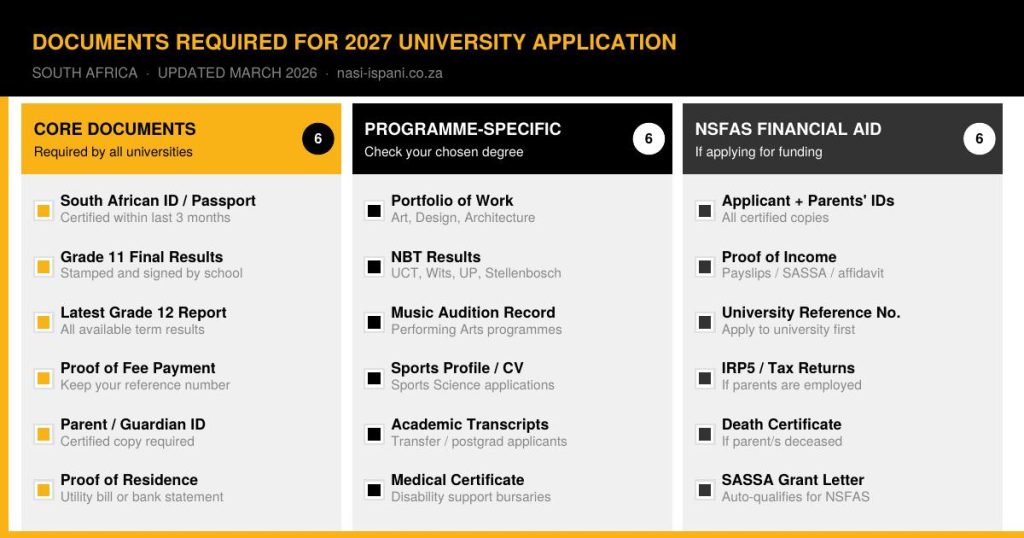
Every South African university requires a core set of documents. Having these prepared, certified, and scanned before applications open will save you significant time and reduce the risk of your application being delayed or rejected.
Core Documents (Required by All Universities)
- Certified copy of your South African ID or passport (certified within the last 3 months)
- Grade 11 final results — stamped and signed by your school principal or secretary
- Latest Grade 12 results or school report (all available term reports)
- Proof of application fee payment — keep your bank reference number
- Certified copy of parent or guardian’s ID (required by most universities)
- Proof of residential address (utility bill or bank statement, not older than 3 months)
Programme-Specific Documents
- Portfolio of work — required for Fine Art, Graphic Design, Architecture, Fashion Design, and Interior Design
- NBT results — required by UCT, Wits, UP, and Stellenbosch. Register at www.nbt.ac.za
- Music audition record — required for Music and Performing Arts programmes
- Sports profile or CV — required for Sports Science and sports bursary applications
Understanding Your APS Score: What It Means and How to Calculate It
The APS (Admission Point Score) is a standardised scoring system used by South African universities to assess whether you meet the academic entry requirements for a specific programme. It converts your matric subject percentages into points on a 1 to 7 scale. Your total APS is the sum of your best six subjects, Life Orientation is excluded from the APS calculation at most universities.
APS Conversion Scale
| Percentage Range | Achievement Level | APS Points |
|---|---|---|
| 80% – 100% | 7 – Outstanding Achievement | 7 |
| 70% – 79% | 6 – Meritorious Achievement | 6 |
| 60% – 69% | 5 – Substantial Achievement | 5 |
| 50% – 59% | 4 – Adequate Achievement | 4 |
| 40% – 49% | 3 – Moderate Achievement | 3 |
| 30% – 39% | 2 – Elementary Achievement | 2 |
| 0% – 29% | 1 – Not Achieved | 1 |
APS Score Requirements by Programme
These are general APS benchmarks to help you assess your competitiveness. Specific requirements vary by institution — always check the official prospectus for your chosen university and programme.
- Medicine (MBChB): 36 – 42+ (plus specific subject marks in Physical Sciences and Life Sciences)
- Law (LLB): 30 – 36 (varies widely by university)
- Engineering (BEng): 30 – 38 (Mathematics and Physical Sciences marks are critical)
- Health Sciences (Nursing, Pharmacy, Physiotherapy): 28 – 36
- Commerce / BCom: 26 – 32 (Mathematics or Mathematical Literacy considered)
- Education (BEd): 24 – 28
- Humanities / BA: 20 – 26
- Diploma programmes: 18 – 24
Enter your NSC subject marks to calculate your Admission Point Score for UP, Wits, UCT and UJ simultaneously.
CAO vs Direct Applications: Which One Do You Use?
One of the most common and costly mistakes South African students make is applying through the wrong portal. There is no single national university application system in South Africa — you need to know which route applies to each university you want to apply to.
What is the CAO?
The Central Applications Office (CAO) is an application processing service used primarily by universities and colleges in KwaZulu-Natal. If you are applying to UKZN, DUT, MUT (Mangosuthu University of Technology), or the Durban University of Technology, you apply through the CAO at www.cao.ac.za. A single CAO application allows you to apply to multiple participating institutions simultaneously.
Which Universities Require Direct Applications?
The majority of South Africa’s universities — including UCT, Wits, UP, Stellenbosch, UJ, UWC, Rhodes, UFS, NWU, NMU, TUT, and CPUT — require applicants to apply directly through the university’s own online student portal. Each university has a separate account, login, and process. Applying via the CAO for these institutions will not work.
NSFAS 2027: How to Apply for Financial Aid
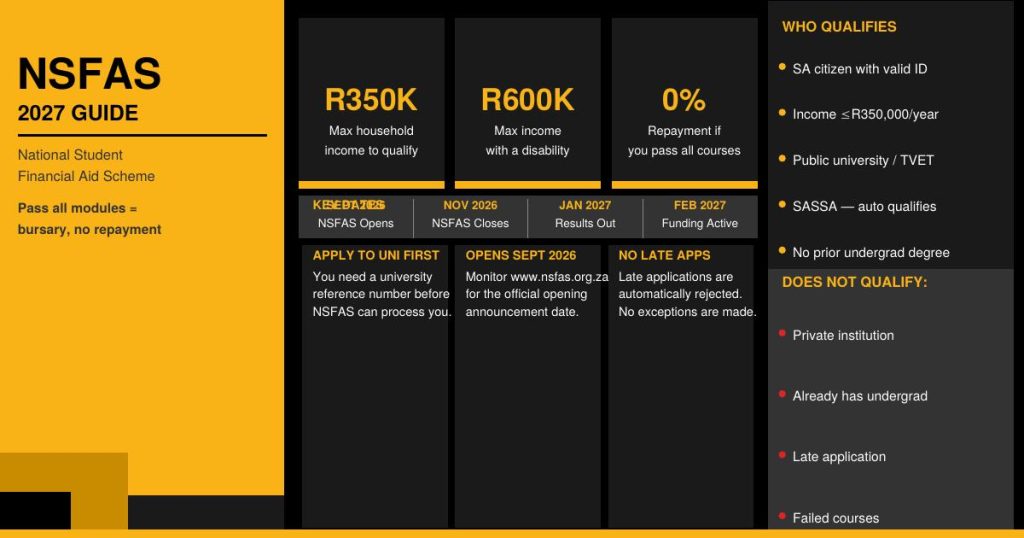
The National Student Financial Aid Scheme (NSFAS) is South Africa’s government-funded bursary programme for students from low-income households. NSFAS can cover tuition fees, accommodation, meals, transport allowance, and a personal care allowance. Crucially, if you pass all your modules, the loan converts into a bursary — meaning you do not have to repay it.
Who Qualifies for NSFAS?
- You are a South African citizen with a valid ID
- You are registered or accepted at a public university or TVET college
- Your combined household income does not exceed R350,000 per year (or R600,000 for students with disabilities)
- SASSA grant recipients qualify automatically
- You have not previously obtained an undergraduate qualification
NSFAS 2027 Application Timeline
NSFAS applications for the 2027 academic year are expected to open in September 2026 and close in November 2026. These dates are announced on the official NSFAS website at www.nsfas.org.za. You will need a confirmed university application or acceptance reference number before NSFAS can finalise your funding — which means you must apply to university first.
Important: Do not wait until you receive university acceptance before starting your NSFAS application. Apply to university as early as possible so you have a reference number ready when NSFAS opens in September.
Common NSFAS Mistakes That Cost Students Their Funding
- Applying after the deadline — late applications are automatically rejected with no exceptions
- Submitting incorrect or incomplete income documentation
- Not updating banking details, leading to payment delays
- Applying at a private institution — NSFAS only funds public universities and TVET colleges
- Failing courses — NSFAS funding does not convert to a bursary if you do not pass
- Not having a university reference number at the time of application
Early vs Late Applications: Why Competitive Degrees Fill Up First
Not all university programmes close at the same time, even within the same institution. South African universities use a rolling admissions model for many of their most competitive degrees — this means they review applications as they come in and begin issuing conditional offers immediately after applications open.
By the time the general closing date arrives in September or October, Medicine, Law, and Engineering programmes at top institutions have typically already filled their available spaces. Students who apply in September to these programmes are often applying for spots that no longer exist.
The practical advice is simple: treat the programme-specific closing date as the real deadline, and treat the general closing date as the absolute last resort for more flexible programmes. For Medicine, Law, Architecture, Physiotherapy, Occupational Therapy, and Pharmacy — submit your application within the first two months of applications opening.
8 Common University Application Mistakes to Avoid
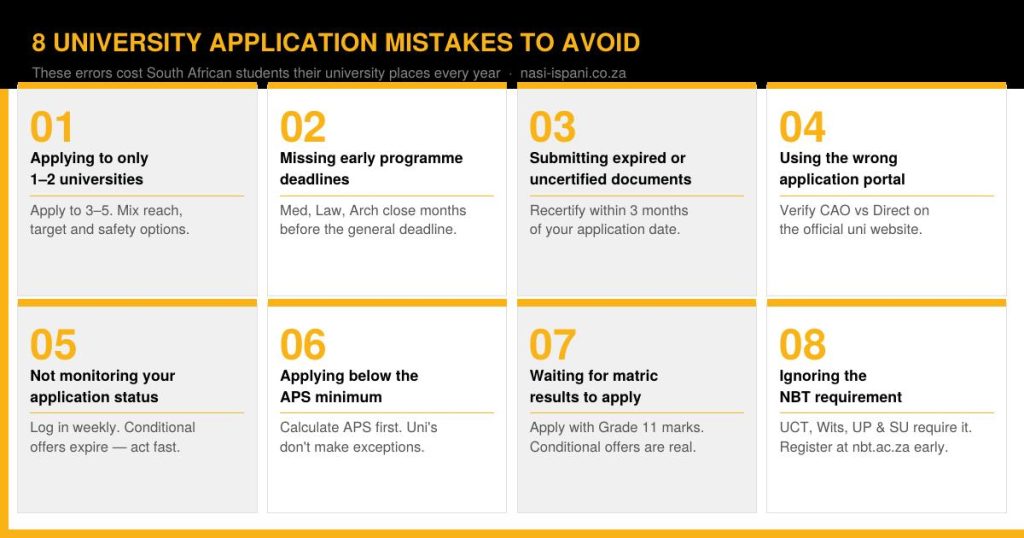
These are the mistakes that cost South African students their university places every year. Review this list carefully before submitting any application.
- Applying to only one or two universities. Always apply to at least three to five institutions. Mix reach, target, and safety options to maximise your chances.
- Missing programme-specific early deadlines. The general closing date is not the deadline for competitive programmes. Check each programme individually.
- Submitting outdated or uncertified documents. Certification must be done within three months of your application date. Recertify if needed.
- Using the wrong portal. Confirm on the official university website whether to apply via the CAO or directly. Applying through the wrong portal wastes your fee and your time.
- Not monitoring your application status. Log in to your portal at least once a week. Conditional offers expire if not accepted in time.
- Applying with an APS below the programme minimum. Calculate your APS before applying. Universities do not typically make exceptions for applicants who do not meet the minimum.
- Waiting for matric results before applying. Most universities accept provisional applications with Grade 11 results and issue conditional offers. Early applicants get priority.
- Ignoring the NBT requirement. UCT, Wits, UP, and Stellenbosch require National Benchmark Test scores. Register at www.nbt.ac.za early — test dates are limited.
How to Track Your University Application Status
After submitting your application, log in to your application portal at least once a week. Understanding what each status means will help you know when to act and when to wait.
- Application Received: Your submission is in the queue. No action needed — wait for the next update.
- Under Review: The university is assessing your APS, subject combination, and available spaces. This can take several weeks.
- Provisionally Accepted: You qualify based on Grade 11 results, subject to your final matric marks meeting the required conditions. Check your email for the specific conditions.
- Conditional Offer: You have been formally offered a place, conditional on your final matric results. Accept before the stated deadline — offers expire.
- Waitlisted: You meet minimum requirements but space is limited. Continue applying to other universities. Spaces may open after January results are released.
- Unsuccessful: Your application was not successful. Apply to other institutions, explore the Central Applications Clearing House (CACH) after January results, or consider related programmes.
Apply Smarter: Strategy for 2027 University Applications
Most guides tell you what to do. This section tells you how to do it better than everyone else applying at the same time.
Apply to 3–5 Universities: Mix Your Options
Structure your university list deliberately. Include one or two reach universities where your APS is slightly below the typical admitted student profile, two target universities where your APS aligns well with the published minimum, and one safety university where you comfortably exceed the minimum requirements. This approach ensures you have strong options regardless of your final matric results.
Apply with Grade 11 Results — Do Not Wait
Universities accept provisional applications based on Grade 11 final results. They issue conditional offers that are confirmed or withdrawn once final matric results are published in January 2027. Students who apply in April with Grade 11 results are in the queue for places that students who apply in September will never see. Do not wait for matric results to apply.
Avoid Portal Crashes: Submit Early
University application portals in South Africa routinely experience crashes and long queues during the last week of September — the peak submission period. Students attempting to submit at the last minute frequently encounter technical problems. Aim to have all applications submitted at least four weeks before each deadline to avoid these issues entirely.
All South African Universities 2027 Application Links
Traditional Universities
| University | Official Application Portal | Closes |
|---|---|---|
| UCT | uct.ac.za – Apply | 31 Jul 2026 |
| Wits | wits.ac.za – Apply | 30 Jun (Health Sci) / 30 Sep 2026 |
| Stellenbosch (SU) | maties.com | 31 Jul 2026 |
| UP | up.ac.za – Apply | 30 Jun 2026 |
| UJ | uj.ac.za – Apply | 30 Sep 2026 |
| UKZN | cao.ac.za (via CAO) | 30 Sep 2026 |
| UWC | uwc.ac.za – Apply | 30 Sep 2026 |
| Rhodes | ru.ac.za – Apply | 30 Sep 2026 |
| UFS | ufs.ac.za – Apply | 30 Sep 2026 |
| UL | ul.ac.za – Apply | 30 Sep 2026 |
| UFH | ufh.ac.za – Apply | 30 Sep 2026 |
| UNIVEN | univen.ac.za – Apply | 30 Sep 2026 |
| WSU | wsu.ac.za – Apply | 30 Sep 2026 |
| UNIZULU | cao.ac.za (via CAO) | 30 Sep 2026 |
| SPU | spu.ac.za – Apply | 30 Sep 2026 |
| UMP | ump.ac.za – Apply | 30 Sep 2026 |
| UNISA | unisa.ac.za – Apply | Aug/Sep 2026 (opens later) |
Universities of Technology
| University | Official Application Portal | Closes |
|---|---|---|
| DUT | cao.ac.za (via CAO) | 30 Sep 2026 |
| TUT | tut.ac.za – Apply | 30 Sep 2026 |
| CPUT | cput.ac.za – Apply | 30 Sep 2026 (opens May 2026) |
| CUT | cut.ac.za – Apply | 30 Sep 2026 |
| MUT | cao.ac.za (via CAO) | 30 Sep 2026 |
| VUT | vut.ac.za – Apply | 30 Sep 2026 |
Comprehensive Universities
| University | Official Application Portal | Closes |
|---|---|---|
| NWU | nwu.ac.za – Apply | 31 Aug 2026 (opens 1 Mar 2026) |
| NMU | mandela.ac.za – Apply | 3 Aug / 30 Sep 2026 |
| SMU | smu.ac.za – Apply | 30 Jun 2026 |
Frequently Asked Questions About University Applications 2027
When do university applications open for 2027 in South Africa?
Most South African universities open 2027 applications between March and April 2026. Wits opened on 2 March 2026, while UCT, UP, UJ, and UWC open on 1 April 2026. UNISA opens much later — typically September 2026 — because it operates as a distance-learning institution on a different cycle.
Can I apply to university with Grade 11 results?
Yes. Most South African universities accept provisional applications based on Grade 11 final results. They issue conditional offers that are confirmed once your final matric results are published in January 2027. Applying with Grade 11 results is strongly recommended — it puts you ahead of the queue, especially for competitive programmes that fill up early.
How many universities should I apply to in South Africa?
Apply to at least three to five universities. Use a mix of reach, target, and safety institutions to maximise your chances. Never rely on a single application — even strong students are sometimes waitlisted or rejected at their first-choice institution due to limited spaces.
What is a good APS score for university in South Africa?
A good APS score depends on your chosen programme. As a general guide: an APS of 20–26 is typically sufficient for Humanities and Education degrees; 26–32 for Commerce and Business; 30–38 for Engineering and Health Sciences; and 36–42 or higher for Medicine. Always check the specific APS requirement for your programme at your chosen university, as minimums vary significantly between institutions.
What is the CAO and do I need to use it?
The Central Applications Office (CAO) processes applications for universities primarily in KwaZulu-Natal, including UKZN, DUT, and MUT. If you are applying to any of these institutions, you apply at www.cao.ac.za. If you are applying to Wits, UCT, UP, Stellenbosch, UJ, or most other universities outside KZN, you apply directly through each university’s own portal — not through the CAO.
When does NSFAS open for 2027?
NSFAS applications for the 2027 academic year are expected to open in September 2026 and close in November 2026. You must have a university application reference number before NSFAS can process your funding. Monitor www.nsfas.org.za for the official opening announcement. Late applications are not accepted — there are no exceptions.
What happens if I miss the university application deadline?
If you miss a university’s application deadline, check whether the institution accepts late applications — some do, for a late fee. After matric results are released in January, the Central Applications Clearing House (CACH) publishes a list of programmes at public universities that still have available spaces. You can apply through CACH at no cost. Private institutions and distance-learning providers also remain open later and offer fully accredited alternative pathways.
Do I need to write the NBT?
The National Benchmark Test (NBT) is required by several universities including UCT, Wits, UP, and Stellenbosch. It assesses academic literacy, quantitative literacy, and mathematics. Register at www.nbt.ac.za — test dates are limited and fill up quickly, so register as early as possible. Check whether your chosen university requires the NBT before assuming it is optional.
University application dates and requirements are verified regularly. Always confirm final dates on the official website of each institution before submitting your application.