

Your LinkedIn profile picture is not just a photo, it’s your digital first impression. Before anyone reads your CV, headline, or experience, they see your image.
- Know Exactly What Your Photo Must Achieve
- Dress for the Industry You Want
- Choose the Right Background
- Master Your Expression
- Use Confident Body Language
- Make Sure the Photo Quality Is Professional
- Get the Size and Format Exactly Right
- Keep It Real and Authentic
- Examples
- Should You Use AI-Generated or AI-Enhanced Profile Pictures?
- Common Questions About AI Profile Pictures
- Best Practice Recommendation
- A Simple Rule to Follow
- Common LinkedIn Photo Mistakes to Avoid
This guide will walk you through a practical, easy-to-follow process to create or choose a LinkedIn profile picture that makes you look professional, confident, and approachable.
Follow these steps like a checklist.
Know Exactly What Your Photo Must Achieve
A LinkedIn profile picture has one clear purpose:
To make you look like someone people want to hire and work with.
Your image should instantly communicate three key qualities:
- Professionalism
- Approachability
- Confidence
Before uploading any photo, ask yourself:
“Does this picture make me look like a trustworthy professional?”
If the answer is no – don’t use it.
Dress for the Industry You Want
Clothing plays a major role in how people judge you online.
Practical Clothing Checklist
- Wear professional, clean, neat clothing
- Choose simple colours (navy, black, grey, white work best)
- Avoid busy patterns or large logos
- Keep accessories minimal
Quick Industry Guide
- Corporate fields (finance, law, HR): formal business attire
- Business roles: smart professional
- Creative industries: smart-casual is fine
- Technical roles: neat and professional, not overly casual
A good rule:
Dress one level more professional than your everyday work outfit.
Choose the Right Background
The background should support your image – not compete with it.
Use:
- Plain walls
- Office-style backgrounds
- Neutral colours
- Simple, uncluttered spaces
Avoid:
- Cars, kitchens, bedrooms
- Busy outdoor scenes
- Party or social settings
- Group photos cropped into a headshot
Remember:
Your background should be invisible, not memorable.
Master Your Expression
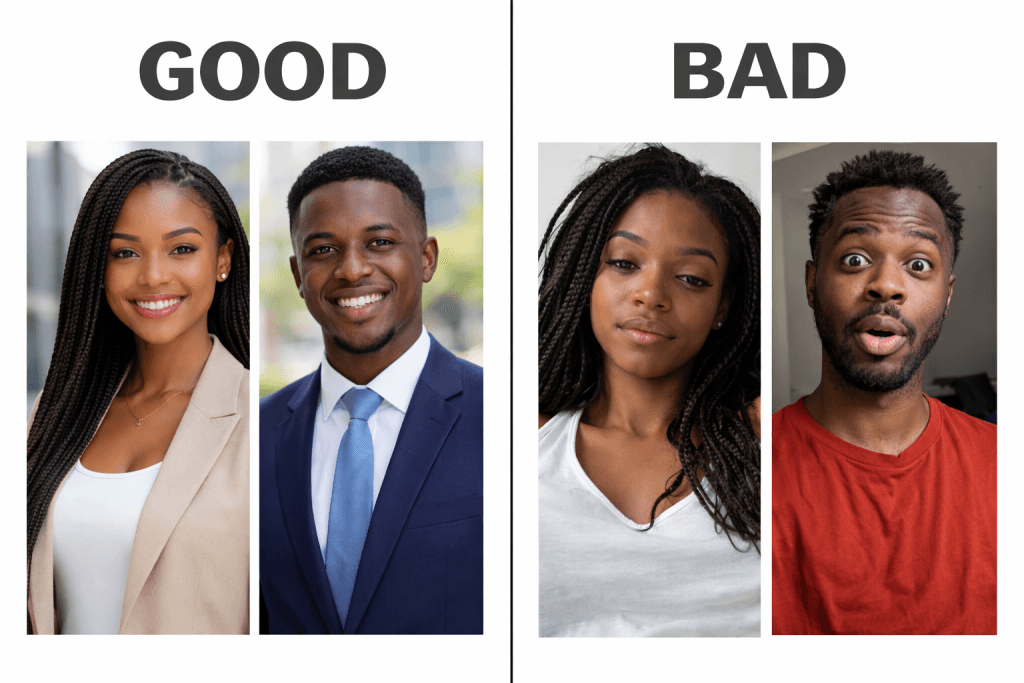
Your facial expression is one of the biggest factors in whether people want to connect with you.
Do This:
- Look directly into the camera
- Smile naturally
- Relax your face
- Aim for a friendly, warm expression
Avoid:
- Serious or angry looks
- Blank expressions
- Looking away from the camera
- Sunglasses or hats
A simple, genuine smile makes you appear:
- More confident
- More trustworthy
- More approachable
Use Confident Body Language
Even in a small profile photo, body language matters.
Best Practices
- Keep your shoulders relaxed
- Sit or stand up straight
- Face slightly toward the camera
- Keep your posture open
Don’t:
- Slouch
- Cross your arms
- Tilt your head at extreme angles
Your body language should quietly say:
“I am confident and professional.”
Make Sure the Photo Quality Is Professional
A great pose can still look bad if the image quality is poor.
Quality Checklist
- Use a high-resolution image
- Ensure good lighting (natural light is best)
- Keep the focus sharp
- Avoid shadows on your face
- Use a recent photo
Never Use:
- Blurry images
- Dark or grainy photos
- Old pictures
- Over-edited or heavily filtered images
Your LinkedIn photo must look like you today – not years ago.
Get the Size and Format Exactly Right
Even a perfect photo can look terrible if it’s uploaded incorrectly.
Here are the exact technical requirements for LinkedIn:
Official LinkedIn Photo Requirements
- Recommended size: 400 x 400 pixels
- Minimum size: 200 x 200 pixels
- Maximum file size: 8MB
- Accepted formats: JPG or PNG
- Image shape: Square
For best results:
Use a photo that is at least 400 x 400 pixels and under 8MB.
How to Crop Your Photo Correctly
LinkedIn displays profile photos as a circle, even though you upload a square image.
To avoid awkward cropping:
- Centre your face in the frame
- Leave a little space above your head
- Use a head-and-shoulders shot
- Don’t crop too tightly
Ideal composition:
- Your face should take up about 60% of the image
- Eyes should be roughly one-third from the top
Resolution Tips
To keep your photo sharp:
- Upload the original high-quality image
- Avoid screenshots
- Don’t use photos downloaded from WhatsApp
- Avoid heavy filters or editing
If it looks blurry on your phone, it will look worse on LinkedIn.
Mobile vs Desktop Display
Remember:
- On mobile, your photo appears small
- On desktop, it appears larger
Always test your picture on both to make sure it looks clear and professional.
Keep It Real and Authentic
Your LinkedIn picture must be a true reflection of you.
Ask yourself:
- Would someone recognise me in real life?
- Does this look like the real me?
- Is this how I would appear in an interview?
Avoid:
- Glamour-style photos
- Extreme filters
- Overly stylised images
- Social media selfies
Authenticity builds trust – and trust creates opportunities.
Examples
Should You Use AI-Generated or AI-Enhanced Profile Pictures?
With the rise of AI photo tools, many people now wonder:
- Can I use an AI-generated LinkedIn profile picture?
- Is it okay to enhance my photo with AI?
- Will recruiters notice?
Let’s address these questions practically and honestly.
Yes, but with limits. AI can be a helpful tool for improving your LinkedIn photo, but it should never replace authenticity. Your profile picture must still look like the real you.
Related: LinkedIn Profile Updates: A Practical Guide for 2026
What’s Acceptable to Do with AI
Using AI is perfectly fine when it’s used to enhance, not transform.
Safe and Professional Uses of AI:
You can use AI tools to:
- Improve lighting
- Sharpen image quality
- Remove minor blemishes
- Clean up backgrounds
- Adjust colour balance
- Convert casual photos into more professional-looking headshots
- Resize and crop correctly
These types of edits are no different from traditional photo editing.
They simply help you present yourself more clearly.
What You Should NOT Do
Avoid using AI in ways that change your real appearance.
Never use AI to:
- Completely generate a fake version of yourself
- Change your facial features
- Make yourself look much younger
- Alter your body shape
- Add unrealistic hairstyles or makeup
- Create an image that looks like a different person
If someone meets you in real life and says:
“You don’t look like your LinkedIn photo”
…then you’ve gone too far.
Common Questions About AI Profile Pictures
1. “Can I upload a fully AI-generated image of myself?”
It’s not recommended.
Even if the image looks professional, many recruiters see fully AI-generated photos as:
- Misleading
- Inauthentic
- Potentially dishonest
LinkedIn is built on trust. A real photo builds more credibility than a digital avatar.
2. “Will recruiters know if I used AI?”
Often, yes.
Overly polished, unrealistic images can raise red flags. Many hiring managers are becoming skilled at spotting AI-generated photos.
If your picture looks too perfect, it can actually work against you.
3. “Is it better than using a bad-quality photo?”
In some cases – yes.
If your only options are:
- A poor-quality selfie
- A heavily filtered social media photo
- A completely unprofessional image
Then an AI-enhanced professional headshot can be a good temporary solution.
But it should still accurately represent you.
4. “What about AI background replacements?”
These are usually fine – as long as:
- The background looks natural
- The lighting still matches
- The final image doesn’t look fake or edited
A clean AI-generated background is much better than a messy real one.
Best Practice Recommendation
Think of AI as a helper, not a replacement for reality.
The ideal approach is:
- Take a real, high-quality photo
- Use AI tools to enhance it
- Keep edits natural and subtle
- Make sure the final image still looks like you
A Simple Rule to Follow
Before uploading an AI-enhanced photo, ask yourself:
“If I walked into a job interview tomorrow, would I look like this person?”
If the answer is yes – you’re safe.
If the answer is no – choose a more authentic image.
Final Thought on AI Photos
AI can help you look clearer, sharper, and more professional.
But it should never make you look like someone you’re not.
Authenticity always wins on LinkedIn.
Common LinkedIn Photo Mistakes to Avoid
Never upload:
- Selfies
- Group photos
- Wedding pictures
- Vacation snaps
- Photos with pets
- Full-body shots
- Pictures with distracting backgrounds
If you wouldn’t see it on a company website, it doesn’t belong on LinkedIn.
Choosing the perfect LinkedIn profile picture doesn’t require a professional studio – it requires the right approach.
By following this practical guide, you can create an image that:
Attracts recruiters
Builds credibility
Strengthens your personal brand
Helps you stand out in job searches
Your LinkedIn photo is more than just a picture, it’s a career tool.
Related resources: Latest Job Opportunities | Internships in South Africa | Learnership Opportunities