




If you’re planning to study through the University of South Africa (UNISA) in 2027, you may need to pay an application fee before your application can be processed.
UNISA’s online application fee for 2027 is R160.00, paid once you receive your student number and non-refundable. This is the fee as published on UNISA’s official application page, checked 13 September 2026. This guide covers when to pay, how to pay, the reference to use and how to submit proof of payment, so your application is processed without delays.
What is the UNISA Application Fee?

The UNISA application fee is a mandatory payment that every prospective student must pay to have their application processed by the University of South Africa (UNISA). This fee applies to online applications for the 2027 academic year and is set at R160.00.
Paying this fee does not guarantee admission, but it ensures that your application will be officially reviewed by UNISA’s admissions department. The fee helps cover the administrative costs associated with processing applications, verifying documents, and allocating student numbers.
This fee is also different from tuition or registration fees. The application fee only covers the processing of your application itself. Once your application is accepted, you will still need to pay tuition fees for the modules you register for.
Additionally, paying the UNISA application fee is your first official step toward becoming a UNISA student. Without this payment, UNISA will not process your application, meaning you cannot be considered for admission until the fee has been received and verified.
When Do You Pay the UNISA Application Fee?
The UNISA application fee is not paid at the time of submitting your online application. Instead, you will pay the fee after UNISA issues your student number.
Your student number is a unique identifier that links your application to the payment. Paying the fee before receiving this number can result in delays or misallocation of your payment, meaning your application might not be processed on time.
Why timing matters:
- Ensures that the payment is linked correctly to your application.
- Prevents unnecessary delays in reviewing your documents.
- Confirms that your application is officially active in UNISA’s system.
In short, the application process is two-step:
- Submit your online application and receive your student number.
- Pay the UNISA Application Fee using the correct reference and submit proof of payment.
How to Pay the UNISA Application Fee
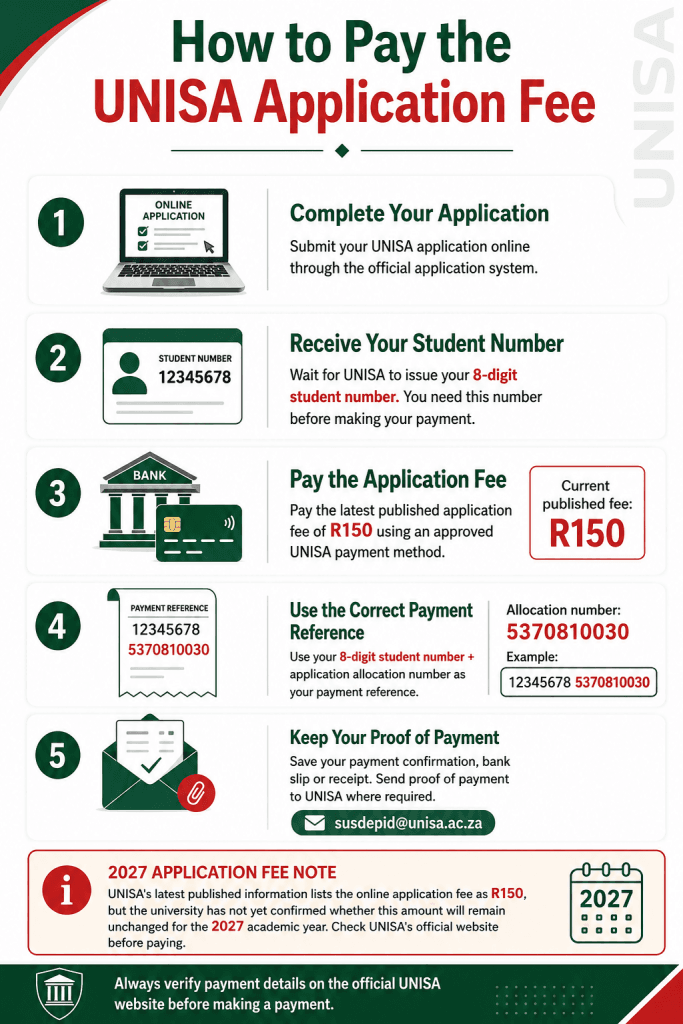
Paying your UNISA application fee correctly is crucial. Here’s a step-by-step guide to make it simple and error-free:
Step 1: Visit the UNISA Fee Payment Page
Go to www.unisa.ac.za/feepayment for official banking details and instructions. Make sure you follow only the information on this page to avoid mistakes.
UNISA Banking Details
If you’re paying your UNISA application fee via EFT or bank deposit, here are the official account details for individual student payments. Always double-check these against UNISA’s fee payment page before paying, since account details can change.
Important: Whichever bank you use, your payment reference must be your 8-digit student number, followed by a space, then 5370810030 (the application fee allocation number). For example: 2026123456 5370810030.
FNB (First National Bank)
| Detail | Information |
|---|---|
| Bank | First National Bank (FNB) |
| Account name | Unisa Student Deposits |
| Account number | 627 9963 0382 |
| Account type | Cheque |
| Branch code | 210554 |
| Reference | [Student number] 5370810030 |
If you’re paying through FNB’s app or online banking, you don’t need to type the account number in manually. UNISA is listed as a pre-approved beneficiary. Just search for “Unisa” in your list of beneficiaries and select it.
ABSA
| Detail | Information |
|---|---|
| Bank | ABSA |
| Account name | Unisa Student Deposit |
| Account number | 4097930634 |
| Account type | Cheque |
| Reference | [Student number] 5370810030 |
ABSA account holders can also pay via cash deposit at any ABSA branch, or select UNISA as a pre-approved beneficiary through ABSA’s online banking.
Note: UNISA only accepts cash deposits at FNB and ABSA branches. No cash or cheques are accepted at UNISA offices directly. The banking details above are for individual student payments only. Employers, sponsors, and bulk payers should use UNISA’s separate income account and send remittance details to susdepid@unisa.ac.za.
Step 2: Use the Correct Reference Number
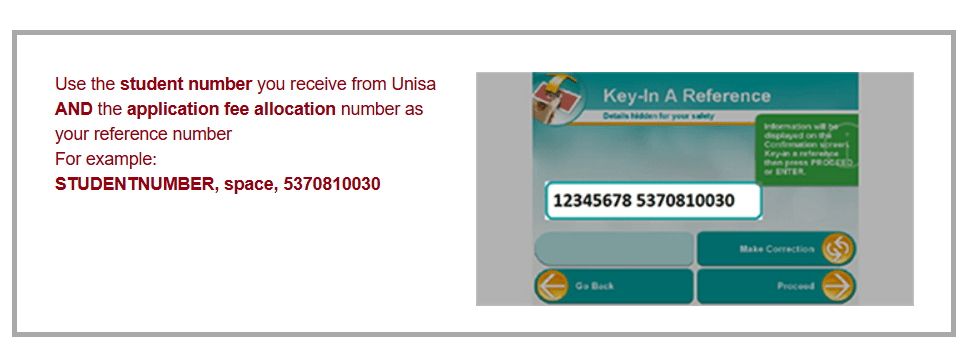
When making the payment, UNISA requires that you use both your student number and the application fee allocation number as the reference.
Format:
Example: If your student number is 2026123456, your reference should be:
2026123456 5370810030
Using the correct reference ensures that UNISA can automatically match your payment to your application.
Step 3: Submit Proof of Payment
After making the payment, you must email proof of payment to:
susdepid@unisa.ac.za
This step confirms that UNISA has received your application fee and can continue processing your application.
Payment Options
UNISA provides secure ways to pay your UNISA application fee, but it’s important to understand the rules, deadlines, and requirements to avoid delays or rejection.
UNISA allows payment through the following channels:
- Bank Deposit / EFT (Electronic Funds Transfer)
- Deposit your R160.00 application fee directly into UNISA’s bank account.
- Use your student number and application fee allocation number as the reference.
- Keep the deposit slip or EFT confirmation as proof of payment.
- Online Payment via myUNISA
- Pay safely using a debit or credit card through the myUNISA portal.
- This method is fast and your payment is processed immediately.
Important: UNISA does not provide cashier services. All application fee payments must be made via bank deposit or online channels.
Key Points to Remember
- Non-refundable fee: The UNISA Application Fee is non-refundable, even if:
- You decide not to study at UNISA.
- You do not qualify for admission.
- UNISA cannot offer you a space due to limited availability.
- Due date: The application fee must be paid on or before the closing date of the application period. Any applications submitted without a paid fee by the deadline will not be processed.
- Keep proof of payment: Always retain a copy of your payment confirmation (screenshot, PDF, or bank slip). UNISA may request it to verify your payment.
Related Content:
- 10 UNISA Online Application Mistakes to Avoid
- UNISA Application Requirements 2027
- UNISA Application Status Check 2027
Make Sure Your Application is Complete
Before submitting, double-check that your application for admission to UNISA is complete:
- Ensure all required documents are attached and correctly uploaded.
- Confirm that your application fee has been paid and proof submitted.
- Incomplete applications cannot be processed and will require you to re-apply during the next application period, which may delay your studies.
Tip: Use the UNISA application checklist to make sure you haven’t missed any steps. This saves time and avoids unnecessary delays.
Common Mistakes to Avoid
Paying your UNISA Application Fee correctly is crucial to ensure your application is processed without delays. Many students make avoidable mistakes that can lead to rejection or having to re-apply. Here’s a detailed list of common mistakes and how to avoid them:
- Paying before receiving your student number
- Your student number is required as part of the payment reference.
- Paying too early may cause your payment to be misallocated, delaying your application review.
- Using the wrong reference format
- Always include your student number and application fee allocation number as the reference.
- Incorrect references may result in UNISA being unable to match your payment to your application.
- Forgetting to email proof of payment
- After paying the fee, email proof of payment to susdepid@unisa.ac.za.
- If proof is not sent, UNISA cannot confirm payment, and your application may not be processed.
- Assuming the fee covers tuition or registration
- The application fee only covers the processing of your application.
- You will still need to pay tuition fees separately once your application is accepted.
- Missing the payment deadline
- The application fee must be paid on or before the closing date of the application period.
- Late payments mean your application will not be considered, and you will need to re-apply during the next application period.
- Submitting incomplete applications
- Applications missing documents or information cannot be processed, even if the application fee is paid.
- Always check that all required documents are uploaded and correct before submitting.
- Not keeping proof of payment
- Save your payment confirmation (screenshot, PDF, or bank slip) in case UNISA requests verification.
- Losing proof of payment can cause unnecessary delays or complications with your application.
- Using unofficial payment channels
- Only pay through UNISA’s official bank accounts or online myUNISA portal.
- Payments made through unofficial channels will not be recognized and may result in your application being rejected.
- Assuming you can pay in installments
- The UNISA Application Fee must be paid in full (R160.00). Partial payments are not accepted.
Tip: Follow UNISA’s official instructions carefully, double-check references, deadlines, and documents. Avoiding these common mistakes will save you time, money, and stress.
Frequently Asked Questions (FAQs)
Can I apply without paying the UNISA Application Fee?
No. UNISA will not process your application until the UNISA Application Fee of R160.00 has been paid and proof of payment submitted. Paying the fee is a mandatory step to ensure your application is reviewed.
Can I pay the UNISA Application Fee in instalments?
No. The UNISA Application Fee must be paid in full. Partial payments are not accepted, and your application will not be processed until the full amount is received.
What if my payment doesn’t go through?
If your payment fails or does not reflect in UNISA’s system:
Check that you used the correct student number and application fee allocation number as your reference.
Verify that you followed the official banking or online payment instructions on UNISA Fee Payment.
Contact UNISA at susdepid@unisa.ac.za with your proof of payment if the issue persists.
Is the UNISA Application Fee refundable if my application is rejected?
No. The UNISA Application Fee is non-refundable, even if:
You do not qualify for admission.
You decide not to register for your chosen program.
UNISA cannot offer you a space due to limited capacity.
What happens if I miss the application fee deadline?
If the UNISA Application Fee is not paid by the closing date of the application period, your application will not be processed. You will have to re-apply during the next application period, which may delay your studies.
How do I confirm that UNISA has received my application fee?
After payment, email your proof of payment to susdepid@unisa.ac.za. Keep a copy of your payment confirmation (screenshot, PDF, or bank slip) in case UNISA requests verification.
Can I pay the UNISA Application Fee at a UNISA campus?
No. UNISA does not provide cashier services. Payments must be made via bank deposit, EFT, or online through myUNISA. Paying at a campus will not be accepted.
Following these steps guarantees that your application is processed efficiently, giving you the best chance of securing a place at UNISA.
Starting your academic journey at UNISA is exciting, and paying the UNISA application fee is the very first milestone. Prepare, pay, and submit – and you’ll be one step closer to achieving your educational and career goals.