


The Fair Pay Bill could reshape recruitment in South Africa by making salary discussions more transparent and fair. The proposed amendment to the Employment Equity Act aims to stop employers from relying on salary history and instead focus on a candidate’s skills, experience, and the value of the role.
- What Is the Fair Pay Bill?
- Why Was the Fair Pay Bill Introduced?
- The Biggest Changes Proposed
- Employers Could No Longer Ask About Salary History
- Salary Ranges Would Become Mandatory
- Employees Would Have Greater Pay Transparency
- Employers Would Need Structured Pay Systems
- What the Fair Pay Bill Means for Job Seekers
- What Employers Should Know
- How Employers Can Prepare Now
- How South Africa Compares Internationally
- Is the Fair Pay Bill Already Law?
- Frequently Asked Questions
If passed, the Bill would prevent employers from asking about previous salaries before making an offer. It would also require salary ranges to appear in job advertisements and protect employees who discuss their pay.
The proposal, introduced by Build One South Africa (BOSA), is still before Parliament. It has not yet become law and may change during the legislative process.
What Is the Fair Pay Bill?
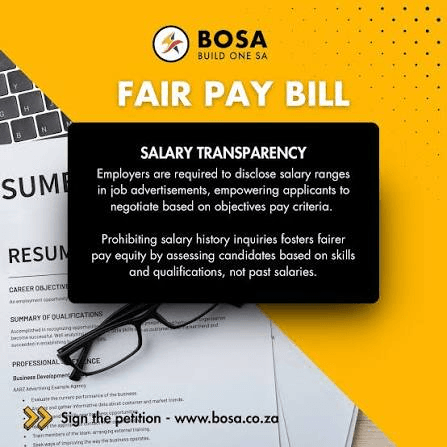
The Fair Pay Bill is a proposed amendment to the Employment Equity Act, 1998. It seeks to improve pay transparency and reduce unfair wage disparities in South Africa.
Supporters argue that many workers remain underpaid because employers often base new salaries on previous earnings. As a result, historical pay gaps continue throughout people’s careers.
The Bill aims to ensure salaries are based on:
- The responsibilities of the role
- Skills and qualifications
- Relevant experience
- Market-related pay
- Objective remuneration policies
RELATED: 50 South African Companies That Will Hire You With Just Matric
Why Was the Fair Pay Bill Introduced?
The Bill was introduced to address ongoing income inequality in South Africa.
According to Statistics South Africa, the country’s income distribution remains among the most unequal in the world. Wage inequality continues to affect women, young professionals, and historically disadvantaged groups.
Supporters believe salary history should not determine future earnings. Instead, employers should assess each candidate on merit and pay fairly for the position.
The Biggest Changes Proposed
If Parliament approves the Bill, employers would need to change several recruitment practices.
The most significant proposals include:
- Banning salary history questions during recruitment.
- Requiring salary ranges in job advertisements.
- Protecting employees who discuss their pay.
- Introducing structured remuneration frameworks.
These measures aim to create a more transparent hiring process.
Employers Could No Longer Ask About Salary History
One of the Bill’s most notable changes is the proposed ban on salary history questions.
Employers would no longer be allowed to request:
- Previous salaries
- Current remuneration
- Payslips
- Salary records
This means employers would not use a candidate’s previous income when deciding a salary offer.
One Important Exception
The latest version of the Bill includes an exception.
After receiving a job offer, a candidate may voluntarily request that their previous salary be considered. This request must be made in writing.
Employers cannot require this information before making an offer.
Salary Ranges Would Become Mandatory
Many South African job advertisements currently use phrases such as:
- Market-related salary
- Competitive remuneration
- Salary negotiable
The Fair Pay Bill would require employers to publish either:
- A specific salary; or
- A salary range.
This would allow applicants to understand the expected remuneration before applying.
It could also reduce wasted applications and improve salary negotiations.
Employees Would Have Greater Pay Transparency
Another important proposal relates to salary discussions.
Many employment contracts discourage employees from discussing their pay with colleagues. The Fair Pay Bill seeks to protect these conversations.
Employees would have greater freedom to discuss:
- Salaries
- Pay increases
- Job offers
- Remuneration structures
Greater transparency could help identify unfair pay differences within organisations.
Employers Would Need Structured Pay Systems
The Bill also encourages employers to adopt more consistent remuneration practices.
Organisations may need to:
- Develop salary bands.
- Document pay decisions.
- Apply consistent remuneration criteria.
- Review existing salary structures.
These measures could reduce arbitrary pay decisions and strengthen compliance with employment equity principles.
What the Fair Pay Bill Means for Job Seekers
For job seekers, the proposed changes could create a fairer recruitment process.
Instead of negotiating from a previous salary, applicants would negotiate based on the value they bring.
Potential benefits include:
- Greater salary transparency.
- Better-informed job applications.
- Fairer salary negotiations.
- Reduced risk of being underpaid.
- More objective recruitment decisions.
Young graduates and first-time job seekers may particularly benefit from these changes.
What Employers Should Know
Although the Bill introduces new compliance requirements, it could also offer long-term advantages.
Potential benefits include:
- Improved employer reputation.
- Greater trust among employees.
- Stronger recruitment outcomes.
- Reduced discrimination risks.
- Better alignment with international pay transparency trends.
However, businesses may also face additional administrative work while updating their remuneration policies.
How Employers Can Prepare Now
Although the Bill has not yet become law, employers can begin preparing.
Practical steps include:
- Reviewing recruitment policies.
- Removing salary history questions from application forms.
- Including salary ranges in job advertisements.
- Conducting internal pay audits.
- Updating remuneration policies.
- Training HR and recruitment teams.
Preparing early could make future compliance easier if the Bill is enacted.
How South Africa Compares Internationally
South Africa is not alone in pursuing pay transparency.
Several countries have introduced similar measures. These include members of the European Union under the Pay Transparency Directive and several states in the United States.
These reforms generally focus on:
- Salary transparency.
- Fair recruitment.
- Equal pay.
- Limiting salary history questions.
The Fair Pay Bill follows many of these international trends.
Is the Fair Pay Bill Already Law?
No.
The Fair Pay Bill is still a proposed amendment before Parliament.
This means:
- Employers can still ask about salary history under current law.
- Job advertisements are not yet required to include salary ranges.
- The proposed changes will only apply if Parliament passes the Bill and the President signs it into law.
Job seekers and employers should monitor developments as the legislative process continues.
Frequently Asked Questions
What is the Fair Pay Bill?
The Fair Pay Bill is a proposed amendment to the Employment Equity Act. It aims to improve salary transparency and reduce wage inequality during recruitment.
Can employers still ask for my payslip?
Yes. At present, employers may still request your salary history or payslip because the Bill has not yet become law.
Will all job adverts need salary ranges?
If the Bill becomes law, employers would generally need to include either a salary amount or a salary range in job advertisements.
Can employees discuss their salaries?
Under the proposed Bill, employees would receive greater protection when discussing their remuneration with colleagues.
Who introduced the Fair Pay Bill?
The Bill was introduced in Parliament by Build One South Africa (BOSA) as a Private Member’s Bill.
Learn more: Employment Equity vs Affirmative Action: What’s the Difference?
The Fair Pay Bill could represent one of South Africa’s biggest employment law reforms in recent years. By promoting salary transparency and reducing reliance on salary history, the proposal aims to create a fairer labour market for both employers and job seekers.
Although the Bill has not yet been enacted, it has already sparked important discussions about pay equity, recruitment practices, and workplace transparency. If approved, it could fundamentally change how South Africans apply for jobs, negotiate salaries, and build their careers.
Related resources: Latest Job Opportunities | Internships in South Africa | Learnership Opportunities